



Nigerians have become so used to hearing that ‘better days are here’ that many citizens now first check the market price of tomatoes before deciding whether to believe any presidential speech about economic recovery.
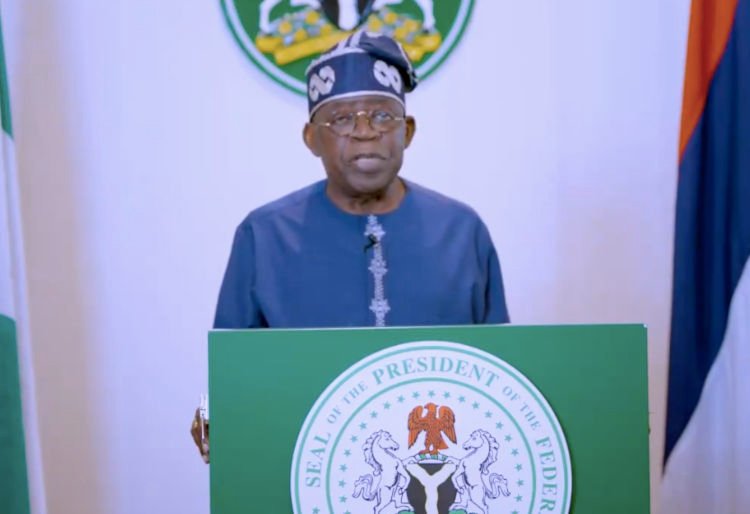
Development Diaries reports that President Bola Tinubu’s recent Eid-el-Kabir message sparked widespread debate after the president declared that ‘the walk through the dark tunnel is over, and the light is here’, while also acknowledging that terrorists and bandits were still attacking communities across the country.
Within hours of the message, Nigerian social media had turned into something between a fact-checking centre and an online complaints office, as citizens responded with photographs of food prices from local markets, electricity blackout complaints, fuel costs, and screenshots comparing the value of the minimum wage between 2023 and 2026.
For many Nigerians, the argument was about whether the tunnel has truly ended, and why does everyday life still feel like people are paying premium rent inside darkness?
The president’s statement about insecurity created an even sharper contradiction because the same message that announced national progress also admitted that Nigerians were still being killed, abducted, and displaced by armed groups across several states.
This is where government communication in Nigeria often becomes difficult to separate from political optimism campaigns, as leaders speak about macroeconomic stability while citizens continue to calculate whether they can afford rice, transport fare, diesel, school fees, and electricity units before the middle of the month arrives.
What ‘stable economy’ actually means
Some macroeconomic indicators have improved compared to the crisis levels recorded after the 2023 subsidy removal and naira floatation policies.
The naira has become less volatile compared to its free-fall period, inflation has slowed compared to earlier peaks, and foreign reserves have shown some recovery.
In fact, government officials and economic advisers now frequently point to increased investor confidence and foreign investment discussions as signs that reforms are beginning to stabilise the economy.
But many Nigerians listening to those explanations are measuring them with market baskets, transport fares, electricity bills, and the number of times food portions inside households have quietly reduced without public announcement.
A food basket that many families could buy for around N25,000 in 2020 reportedly rose to about N85,000 in 2023 and now approaches roughly N147,000 in several urban markets in 2026.
For citizens earning nearly the same income while paying far more for survival, the slowing of inflation feels more like suffering becoming slightly less aggressive.
In many Nigerian homes today, citizens joke that government economists and ordinary people must be living inside two separate economies connected only during television interviews.
Insecurity acknowledgment
Nigeria continues to record deadly attacks across several northern and central states, with communities in Zamfara, Katsina, Borno, Kaduna, Niger, and parts of the north central still experiencing killings, kidnappings, displacement, and armed attacks despite repeated assurances from government officials.
Recent public discussions around anti-bandit legislation in Sokoto, protests against insecurity by religious groups in Lagos, and repeated reports of abductions across highways and rural communities continue to reinforce public anxiety about safety.
Statements like ‘you are neither abandoned nor forgotten’ sound emotionally comforting but politically incomplete because citizens increasingly want measurable accountability instead of sympathetic language.
People want to know how many communities have actually become safer; how kidnappers have been prosecuted; how intelligence failures are being addressed; and why insecurity still spreads despite years of security spending.
What the law says
Section 14(2)(b) of Nigeria’s constitution states clearly that the security and welfare of citizens shall be the primary purpose of government.
That constitutional responsibility becomes difficult to separate into neat categories where economic indicators improve on paper while citizens continue to face insecurity, hunger, and unstable living conditions in practice.
Gender and equity lens
Women continue to carry a disproportionate share of Nigeria’s economic crisis because they are often the primary managers of household survival under inflationary conditions.
In markets across the country, women regularly negotiate food prices, stretch shrinking household budgets, and absorb the emotional pressure of keeping families fed while prices continue to rise faster than incomes.
Women in insecurity-affected communities also face additional risks linked to displacement, school disruption, sexual violence, and economic instability created by repeated attacks.
So, for many women raising families under current economic conditions, the national conversation about recovery often feels disconnected from the exhausting mathematics of daily survival.
People-centered response
Citizens should begin to build local accountability records within their communities by consistently documenting food prices, electricity supply, transport costs, and security incidents in ways that create independent public evidence beyond official speeches.
When communities collectively track these realities over time, they create citizen-owned data capable of testing whether government claims are improving everyday life or simply improving political messaging.
The National Bureau of Statistics (NBS) should also publish simpler and more accessible citizen welfare updates showing state-by-state data on food prices, electricity supply, security incidents, and employment conditions in formats ordinary Nigerians can easily understand without needing economic interpretation from television analysts.
Governance communication becomes more credible when citizens can see their own lived realities reflected honestly in the data the government presents publicly.