

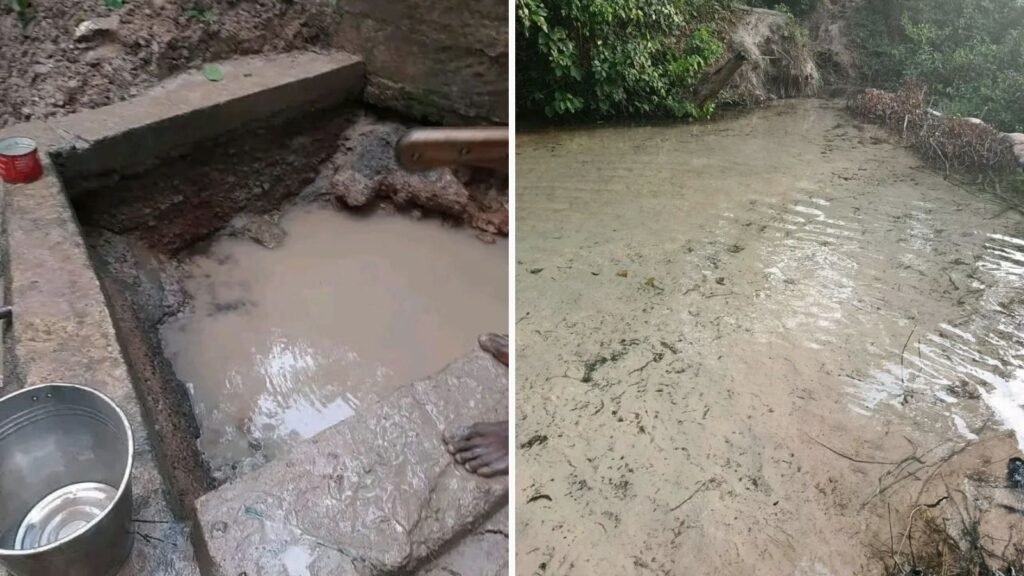
The community of Enugu State Deputy Governor Ifeanyi Ossai still relies on a stream shared with cattle as its main source of drinking water.
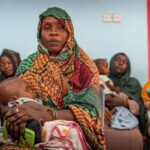
Development Diaries reports that residents of Urukpa Ezimo, in Udenu local government area of the state, say they have no access to clean water and are forced to fetch water from a stream where cattle also drink, bathe and defecate.
Governments often blame the absence of clean water on remoteness or inadequate resources, but when the affected community belongs to the state’s second-highest-ranking public official, distance from power can no longer explain the neglect.
The situation exposes the routine failure of rural water delivery, where boreholes are announced but never completed, existing facilities break down without repairs, and communities outside major towns are left to depend on unsafe natural water sources.
That failure points directly to the institutions responsible for preventing it. The government of Enugu State and the state’s Rural Water Supply and Sanitation Agency (RUWASSA) are mandated to provide safe water in underserved communities, while the Federal Ministry of Water Resources sets national targets that state governments are expected to achieve.
Nigeria has endorsed the human right to safe water and sanitation and committed itself to achieving universal access under the Sustainable Development Goals by 2030. Access to clean water also underpins the right to health recognised in the country’s constitutional framework.
Asking people to drink from a stream shared with livestock exposes them to cholera, typhoid and other preventable diseases that public institutions are expected to stop, not normalise.
Women and girls carry the heaviest burden whenever clean water disappears because they are usually responsible for fetching it. Every journey to a contaminated stream takes time away from school, work and family life, while pregnant women, children, older persons and people living with disabilities face even greater health and mobility challenges.
Families with little income cannot simply drill private boreholes or buy bottled water, leaving the poorest households with the fewest choices and the greatest risks.
The situation also exposes a broader weakness in Nigeria’s federal system. Basic services are supposed to become more accessible as government moves closer to the people, but rural communities continue to wait for water projects that rarely extend beyond state capitals and major urban centres.
If clean water has not reached the deputy governor’s own community, many settlements without political visibility are likely facing even worse conditions.
Residents can petition RUWASSA for an immediate water project, make the agency’s response public and organise as a community to present a costed request during the next local government budget or public engagement session.
The Enugu State government should publish a costed and time-bound plan to provide safe water to the affected community, while the State House of Assembly should require RUWASSA to account publicly for rural water coverage across every senatorial district and explain why communities are still relying on streams shared with cattle.