



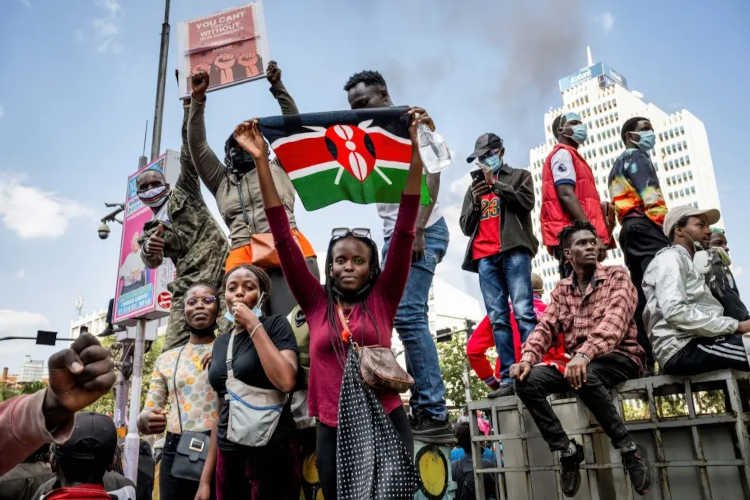
Africa’s biggest democracies are beginning to look less like homes of public accountability and more like governments struggling to keep citizens quiet while economic pressure keeps rising.
Development Diaries reports that within the same week, Nigeria slammed a leading civic organisation with a N100 million SLAPP judgment, Senegal’s ruling coalition collapsed into internal crisis, Kenya pushed forward another controversial Finance Bill targeting citizens already squeezed by rising living costs, and South Africa continued watching anti-migrant violence spread while arrests and prosecutions remained painfully weak.
While these may look like separate national problems unfolding at the same time, underneath them sits the same continental story of governments facing economic pressure, approaching politically sensitive elections, and responding by tightening the civic space citizens use to question power.
In Nigeria, the Social Economic Rights and Accountability Project (SERAP) judgment did not shock many civil society actors because they say it fits into a growing pattern where criticism increasingly attracts legal intimidation, security pressure, or political hostility.
The country is already deep inside painful economic reforms that have pushed transport, food, electricity, and living costs beyond what many households can comfortably survive.
And as elections are approaching, governments under pressure rarely enjoy loud accountability voices asking difficult questions every week.
In Senegal, the crisis surrounding President Bassirou Diomaye Faye and Prime Minister Ousmane Sonko exposed the danger of political movements built heavily around personalities instead of institutions.
The same youth movement that once looked like Africa’s strongest democratic hope is now watching internal power struggles weaken the reform energy that brought it into office.
Many young Senegalese citizens who marched, protested, and voted for systemic change are suddenly discovering that removing an old political establishment is not the same thing as building a stable alternative.
Over to Kenya, where its Finance Bill tells another version of the same story. Citizens who shut down a previous finance bill through online mobilisation and mass protest are now facing new tax proposals targeting the same digital spaces and tools that helped them organise resistance in the first place.
Many young Kenyans increasingly feel like every budget cycle now arrives with government officials searching for fresh ways to enter citizens’ pockets while unemployment and living costs continue climbing.
The frustration is becoming predictable enough that each Finance Bill now feels less like economic planning and more like waiting for the next round of argument between citizens and the state.
Then there is South Africa, where migrants continue paying the price for an economy that has failed too many citizens for too long. African migrants are attacked in communities struggling with unemployment, poverty, and insecurity, while government condemnation often sounds stronger at press conferences than inside courtrooms.
Citizens hear speeches against xenophobia, but many still struggle to remember major convictions that truly discouraged future attacks. And the message this creates is dangerous because when violence repeatedly happens without serious punishment, society slowly begins treating it like bad weather.
What connects these four countries is the pressure governments face when economies weaken, elections move closer, and public frustration grows faster than public trust.
Under those conditions, civic space often becomes one of the first casualties, as governments begin to see journalists, activists, protest movements, and accountability organisations less as democratic partners and more as political threats that must be managed carefully before elections arrive.
The irony is that African governments often defend democracy loudly at international summits while weakening the everyday conditions that make democracy meaningful at home.
What citizens should know
The African Charter on Human and Peoples’ Rights guarantees freedom of expression, assembly, and participation in governance. These are the systems that prevent democracies from quietly sliding into controlled political spaces where citizens can vote but cannot meaningfully challenge power between elections.
Women across these civic struggles carry additional burdens that are often ignored, with women journalists, women activists, and women-led organisations in Nigeria, Kenya, Senegal, and South Africa facing harassment that combines political intimidation with gender-based abuse.
In fact, female voices speaking publicly about corruption, governance failure, or violence are frequently attacked for what they say, and daring to speak loudly in political spaces still dominated by men.
Citizens across Africa may now need to stop treating these governance crises as isolated national dramas and begin recognising the broader continental pattern emerging underneath them by sharing the analytical frame with their civic networks and joining civil society coalitions that are tracking the convergence.
As for institutions, the African Union must convene an emergency governance assessment addressing the simultaneous democratic stress across these countries. The AU’s Shared Values Framework on Democracy, Elections, and Governance exists to address exactly this pattern.
It must be activated and applied, with named recommendations for each of the four countries, before the next electoral cycle in any of them consolidates the governance contraction.
Nigeria’s civic pressure, Kenya’s taxation battles, Senegal’s political fractures, and South Africa’s violence all point towards the same uncomfortable question about what happens to democracy when governments facing economic pressure start viewing accountability itself as a problem to control.
That question may become one of Africa’s defining political tests as the continent moves closer to another major election cycle.
Photo source: Sipa/AP Images