



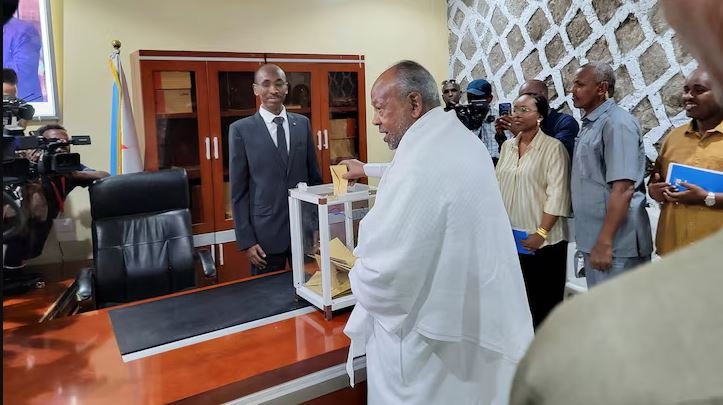
President Ismaïl Guelleh’s recent re-election stretching his time in power beyond 27 years in Djibouti raises questions about the country’s commitment to democratic pricnciples.
Development Diaries reports that President Guelleh secured yet another re-election in a country that has quietly become one of the most militarily valuable pieces of land in the world.
While on paper, Djibouti a small nation with less than a million people, it is prime real estate for global powers, sitting at the Bab-el-Mandeb Strait where a significant portion of global trade passes, and hosting military bases from the United States, France, China, and Japan all at once.
What this means in simple terms is that while other African leaders are asked tough questions about democracy, elections, and human rights, Djibouti’s leadership is often left alone to manage its affairs without the same level of pressure.
When your country is that useful to powerful friends, accountability begins to look optional, a pattern where geopolitical importance quietly buys political comfort.
Across the continent, countries that offer something the world needs, whether it is oil, security partnerships, or strategic location, often find themselves enjoying a softer version of scrutiny.
But for ordinary citizens in Djibouti, usefulness on the global stage has not exactly translated into comfort at home, with reports pointting to high unemployment, especially among young people, and growing inequality in a country that earns significant revenue from hosting foreign military bases.
The money is coming in, but the question many citizens are left asking is where it is going, and more importantly, who it is working for.
In a functioning democracy, that question would be answered through strong institutions, competitive elections, and a free press that can hold leaders accountable.
But when one leader stays in power for nearly three decades, and opposition space continues to shrink, those channels begin to close, leaving citizens with a system where decisions are made, but not necessarily explained.
Even continental institutions like the African Commission on Human and Peoples’ Rights are not immune to this pattern, as there is growing concern that some countries receive more attention than others when it comes to governance and human rights issues.
For citizens, this is where the issue becomes personal because democracy should be about whether people can speak freely, choose their leaders, and see public resources used in ways that improve their lives.
When those basic expectations are quietly set aside because a country is strategically important, it creates a system where citizens are asked to accept less than they deserve.
And for African leaders and institutions, strategic partnerships should not become a shield against accountability, as the African Union was built on principles that include democratic governance and respect for human rights.
The international powers with military bases in Djibouti also have questions to answer, as their presence comes with influence, and with influence comes responsibility.
Photo source: Reuters/Abdourahim Arteh