






A continent that talks endlessly about African unity still has no reliable way to protect Africans from fellow Africans when politics and economic frustration turn them into targets.
Development Diaries reports that more than 1,000 Nigerians have already registered for evacuation from South Africa following a fresh wave of xenophobic threats and intimidation, forcing many migrants to abandon businesses, homes, and livelihoods they spent years building.
One of them is a Nigerian woman who ran a small provisions store in Johannesburg’s Turffontein neighbourhood. She decided to leave because men were moving through the area, smashing windows and warning foreign shop owners to leave before 30 June.
After seven years of building her business, she joined more than 1,092 Nigerians who signed up for the evacuation programme announced by the Nigerian government.
Her story captures the tragedy of a crisis Africa keeps pretending is temporary, as citizens leave their countries because opportunities are scarce, build new lives elsewhere on the continent, get chased out when tensions rise, return home with little to show for years of work, and then watch governments issue statements that change almost nothing before the next cycle begins.
This is now the fifth major wave of xenophobic violence targeting African nationals in South Africa within 16 years, with the script becoming painfully familiar.
While Nigeria’s Minister of Foreign Affairs, Bianca Odumegwu-Ojukwu, was meeting President Bola Tinubu to discuss possible diplomatic responses, including a review of bilateral privileges, South African President Cyril Ramaphosa was addressing his nation with a five-point immigration enforcement plan that included deportation courts, tougher border controls, biometric population registers, and stricter penalties for employers hiring undocumented migrants.
Both governments were responding to an immediate crisis, but neither was confronting the failure that keeps producing the same crisis over and over again.
It is understood that more than 1,000 Nigerians registered for voluntary evacuation by 08 June, while Ghana had already begun receiving returning citizens through support programmes at Accra International Airport.
Political response to a vigilante deadline
Anti-migrant groups publicly issued a 30 June ultimatum, and 22 days before that deadline, the South African government announced a sweeping immigration enforcement plan.
The timing matters because the measures announced cannot realistically be implemented before 30 June, as biometric registers cannot be established within weeks, new courts cannot become fully operational overnight, and thousands of labour inspectors cannot be recruited and trained in a matter of days.
The announcement was therefore less about immediate implementation and more about political signalling, and the problem is that the constitutional rights of migrants, whether documented or undocumented, occupied far less space in the public conversation than enforcement measures did.
Ramaphosa himself acknowledged a central truth when he noted that South Africa continues to face severe unemployment, particularly among young people, and that migrants are not responsible for all the country’s economic problems.
That acknowledgment is important because unemployment and economic frustration are precisely the conditions that allow anti-migrant movements to attract support.
The continental failure
For decades, African leaders have spoken about free movement, regional integration, and continental solidarity, with Agenda 2063 presenting free movement across Africa as a cornerstone of the continent’s future.
Five major xenophobia crises later, there is still no binding continental framework that automatically activates when African citizens become targets in another African country.
So, what remains absent is an enforceable architecture capable of protecting ordinary people when violence begins.
The most revealing fact about this crisis may be that the African Union has never convened an emergency session dedicated specifically to xenophobia-driven displacement within Africa and tasked itself with producing binding protection standards.
That silence says more about the state of continental governance than any diplomatic statement issued during the current crisis.
Women and children pay the highest price
Women working in informal trade are usually among the first to suffer economic losses because their businesses are frequently concentrated in the local markets and neighbourhoods where anti-migrant campaigns gain momentum.
For undocumented women, the risks become even greater, as limited access to formal evacuation channels leaves many trapped between remaining in hostile environments and attempting uncertain journeys home without institutional support.
Children face their own disruptions, as schooling is interrupted, friendships are severed, and families are uprooted. Nigeria’s Foreign Affairs Minister specifically referenced reports of intimidation involving African children in South African schools, highlighting how xenophobia extends beyond economics into everyday social life.
What needs to happen
Citizens should begin to ask harder questions whenever governments issue diplomatic protests over xenophobic attacks, and the most important question is what proposal their government is taking to the African Union to prevent the next crisis.
For institutions, the African Union Commission should convene an emergency session dedicated specifically to xenophobia-driven displacement within Africa and develop binding minimum standards for migrant protection that apply across member states, regardless of immigration status.
In South Africa, the Human Rights Commission should publicly state before 30 June that vigilante deadlines carry no legal authority, that violence against migrants will be prosecuted, and that law enforcement officers who fail to protect vulnerable communities will face consequences.
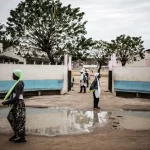
Photo source: Reuters/Ihsaan Haffejee