




West Africa is facing a growing security threat that is moving south from the Sahel into coastal states, and the governance gaps enabling this expansion are still not being addressed with the urgency required.
Development Diaries reports that fighters linked to Jama’at Nusrat al-Islam wal-Muslimin (JNIM) recently overran the military base in Djibo, Burkina Faso, killing up to 200 soldiers in an attack that now forms part of a wider pattern of escalating violence documented in the 2026 Global Terrorism Index.
Djibo is in Burkina Faso, but the conditions that made it vulnerable, including weak governance, youth unemployment, limited state presence and deepening local distrust, are not confined to that country alone, as similar vulnerabilities already exist in varying degrees across northern Ghana, northern Ivory Coast, northern Togo and northern Benin.
The Sahel pattern already writing evidence
The Sahel experience has now moved beyond isolated incidents into a pattern that is difficult to ignore, as Mali, Burkina Faso and Niger all experienced military coups between 2020 and 2023 that were justified on the grounds that civilian governments had failed to contain jihadist violence and that military rule would restore security and order.
What has followed, however, has been a deepening of the crisis rather than a reversal of it, as violence in these countries has continued to escalate and in some cases civilian deaths linked to state forces and allied militias have exceeded those caused by armed groups themselves.
JNIM has also adapted in ways that make it more difficult to contain because it does not operate only as a fighting force but as a system that feeds on governance gaps, offering informal justice, local protection, and alternative authority structures in communities where the state is absent or mistrusted.
What that means is that by the time military responses arrive, the group has often already embedded itself socially.
Southward movement
Documented presence and recruitment activity linked to JNIM and allied groups have been reported across border areas between Burkina Faso and Ghana, Niger and Benin, and into northern Ivory Coast, while Ghanaian security services have also acknowledged early recruitment signals in northern communities.
Coastal West African states are not ignoring the threat entirely, as Ghana, Ivory Coast, Togo and Benin have all increased border security measures and improved coordination, while Ghana has publicly acknowledged the risk in international forums. This includes President John Mahama’s remarks at Chatham House, which framed terrorism as a regional challenge requiring collective action.
However, acknowledgment alone does not stop recruitment because the conditions that make communities vulnerable are both security and governance gaps that include unemployment among young people in northern regions, weaker public service delivery compared to southern regions and lower levels of trust in national institutions.
ECOWAS between strategy and reality
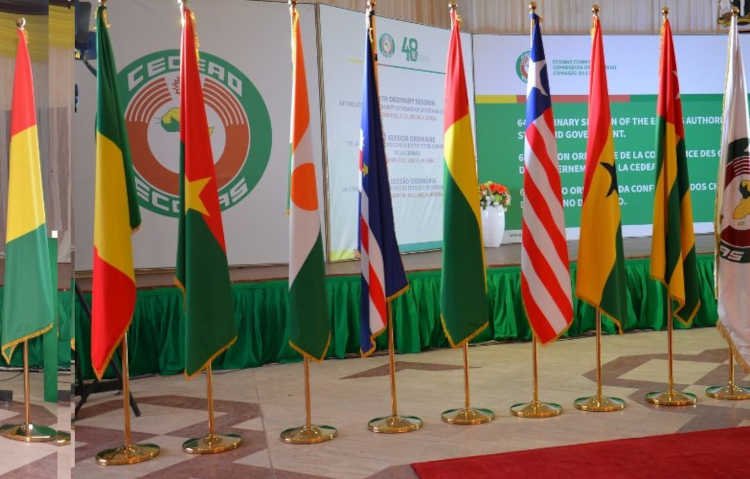
The Economic Community of West African States (ECOWAS) now finds itself in a weakened position as Mali, Burkina Faso and Niger have withdrawn to form the Alliance of Sahel States, leaving the regional body without some of the most affected countries in its security coordination framework.
This creates a structural contradiction where the epicentre of the crisis is no longer fully inside the coordination mechanism designed to manage it, even though the threat itself continues to move across borders and into coastal states.
ECOWAS still maintains a counter terrorism strategy on paper but implementation is constrained by funding gaps, political fragmentation and limited operational reach.
What West Africa is not doing enough of
Across coastal states, there are existing frameworks that could reduce vulnerability if properly implemented, including decentralised governance structures in Ghana, reconciliation and community rebuilding frameworks in the Ivory Coast and community policing models in Benin.
The dominant response continues to lean towards military deployment, which addresses immediate threats but does not resolve the underlying governance failures that allow recruitment ecosystems to develop in the first place.
Gender and equity lens
Women in border communities are often the first to notice shifts in social behaviour and emerging influence networks. At the same time, when extremist groups expand influence, women and girls often face immediate restrictions on movement, education and economic participation, while also being drawn into informal roles within those systems.
Girls’ education in these regions is particularly vulnerable because it is often the first system to collapse under pressure.
What West Africa must do now
For citizens, particularly in northern border communities, the priority is early documentation and reporting of unusual financial flows, recruitment patterns or parallel authority structures to credible civil society organisations so that early warning signals are not lost before they reach formal security channels.
For institutions, ECOWAS must move from strategy to implementation by operationalising its counter terrorism framework with funding, timelines and community-level interventions across coastal states, while national governments must publish clear and time-bound resilience plans for border regions that combine security, governance strengthening, and youth employment interventions.