


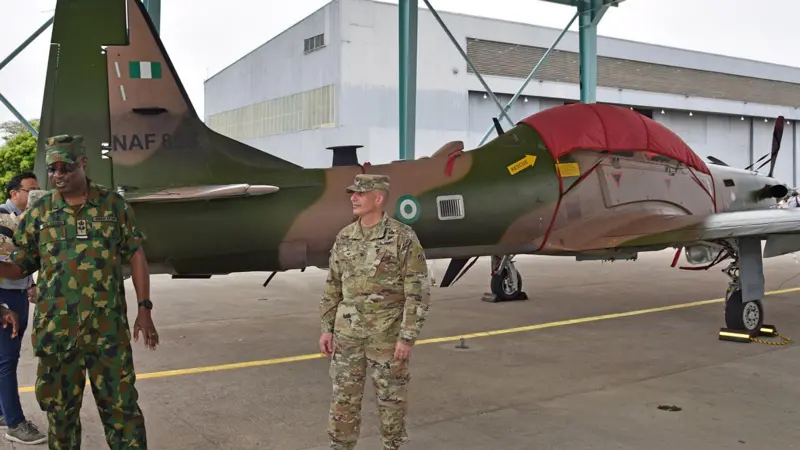
Nigerians found out that foreign soldiers had entered, operated, and largely left their country only after an American general announced it.
Development Diaries reports that a commander of the United States Africa Command (AFRICOM), General Dagvin Anderson, recently disclosed during a virtual briefing that most of the approximately 200 US troops recently deployed to northeastern Nigeria had been withdrawn following a joint operation against the Islamic State in West Africa Province (ISWAP).
Disclosing this after the African Chiefs of Defence Conference in Luanda, Angola, he added that some personnel would remain to continue intelligence-sharing support requested by Nigeria.
The disclosure was remarkable because Nigerians learned about both the deployment and the withdrawal from a foreign military commander instead of their own government.
By the time Anderson spoke, neither the presidency, the Ministry of Defence nor the Nigerian army had publicly explained when the troops arrived, the legal basis for their deployment, how long they stayed, or what form of intelligence cooperation would continue after their departure.
Recall that the deployment followed a bilateral security arrangement reached after the United States announced the killing of Abu-Bilal al-Minuki, whom President Donald Trump described as the second-in-command of the Islamic State globally.
The White House confirmed the operation, while Nigeria acknowledged its cooperation with the United States. Armed personnel from another country were therefore operating on Nigerian soil under an agreement whose terms have never been publicly explained.
That raises a constitutional question that extends beyond military operations, as Nigeria’s constitution does not treat international security agreements as private arrangements between governments.
Section 12 provides that international agreements have legal effect only after they have been enacted into law by the National Assembly, while executive powers under Section 5 must be exercised within constitutional limits.
The National Assembly already has committees responsible for defence, the army and foreign affairs, with oversight responsibilities covering security cooperation and military deployments.
However, there is no public record showing that lawmakers were briefed on the deployment, its duration, its mandate or the intelligence-sharing arrangement General Anderson said would continue.
Several important questions therefore remain unanswered. General Anderson said ‘most’ of the troops had left Nigeria, but ‘most’ is not an accountability figure. Nigerians still do not know how many remain, where they are stationed or how long they will stay.
He confirmed that intelligence-sharing continues, but Nigerians have not been told what that arrangement covers, who supervises it, or how accountability will be ensured if intelligence supplied under the partnership contributes to military operations that affect civilians. And if those details, or some of them, cannot be disclosed, citizens deserve to know why.
The broader concern is that Nigeria has repeatedly entered security partnerships with foreign governments without meaningful public scrutiny by the National Assembly.
The difference this time is that the existence of the deployment became public only because an American general mentioned it while speaking at an international conference. Had he remained silent, Nigerians might never have known that foreign troops had entered, operated and largely left their country under an agreement their own government never publicly explained.
The accountability gap is especially significant for communities in Borno, Yobe and Adamawa, where years of counter-insurgency operations have shaped everyday life, with women, children and other civilians living in displacement camps and conflict-affected communities repeatedly experiencing the consequences of military operations.
Without a publicly available mandate governing the deployment of foreign troops, civil society organisations and affected communities have little basis for monitoring those operations or raising concerns when necessary.
Civil society organisations should formally request public hearings before the Senate and House Committees on Defence, asking the Executive to explain the legal basis for the deployment, the number of personnel involved, the duration of the mission and the intelligence-sharing arrangement that remains in place.
If the National Assembly declines to hold such hearings, that decision should itself become part of the public accountability record.
The National Assembly should also require the executive to publish a comprehensive account of the deployment, including its legal authorisation, the number of troops involved, the duration of the mission, the framework governing intelligence sharing, and the constitutional review conducted before the agreement took effect.
Future deployments of foreign military personnel should be subject to formal notification of the relevant parliamentary committees before such operations begin.
File photo source: US Africa Command/X