





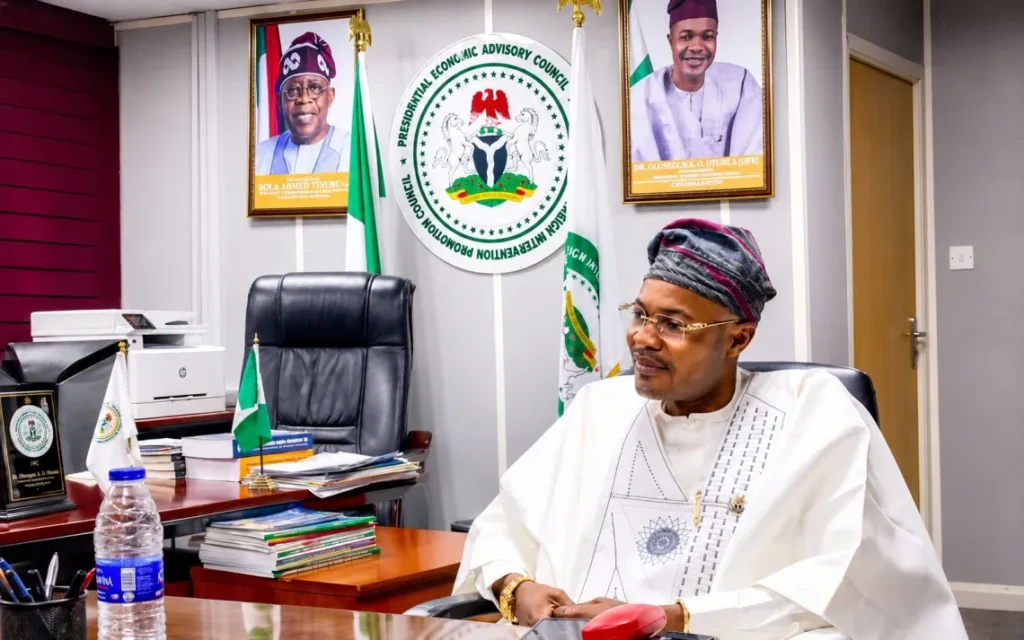
A body that senior government officials now say did not even exist reportedly operated a Central Bank of Nigeria (CBN) account, exposing a serious weakness in Nigeria’s public financial management system.
Development Diaries reports that the controversy surrounding the entity known as the Presidential Fiscal and Infrastructure Projects Council (PFIPC) has quickly moved beyond allegations against one individual into a much bigger test of Nigeria’s public finance system.
Police have arrested the father of Adeniyi Adeyemi, the man at the centre of the controversy, while his hometown of Ogbomoso and Chief of Staff to the President, Femi Gbajabiamila, have publicly distanced themselves from him.
More significantly, the presidency and the Office of the Accountant-General of the Federation are giving conflicting accounts over a CBN account linked to a council whose legal existence senior government officials cannot confirm, prompting President Bola Tinubu to direct the Independent Corrupt Practices and Other Related Offences Commission (ICPC) to investigate and submit its findings within 30 days.
The conflicting positions expose a more fundamental problem. Nigeria’s Treasury Single Account (TSA) framework requires every federal account to be linked to a legally established institution with a recognised mandate, proper documentation and identifiable budgetary authority.
If an organisation whose existence is now under dispute reportedly operated through the CBN, then one of the country’s most important financial safeguards appears to have failed.
For that reason, the investigation cannot stop with Adeyemi. The Office of the Accountant-General of the Federation registers and verifies federal accounts, the CBN authorises them, and the Office of the Secretary to the Government of the Federation verifies the legal status of federal bodies. If a disputed government body reportedly operated an official government account, every institution responsible for those controls deserves scrutiny.
The controversy therefore extends beyond criminal liability and raises constitutional questions about how public resources are managed. Section 16 of Nigeria’s constitution requires the state to manage public resources for the common good, while the Fiscal Responsibility Act promotes transparency in public finance. The Freedom of Information Act also gives citizens the right to know which institutions are legally authorised to collect money on behalf of the federal government.
The consequences of weak financial controls are felt most by ordinary Nigerians. The market woman asked to pay a levy she cannot verify, the artisan pressured to obtain a permit from an agency he has never heard of, and the small business owner who parts with hard-earned money because refusing to pay could interrupt the day’s work are usually the first victims of agencies that trade on the appearance of government authority.
Women, who make up a significant share of Nigeria’s informal trading economy, face even greater exposure because they encounter these fee collection points more frequently while having fewer opportunities to challenge unlawful demands or recover lost money.
That is why anti-corruption experts have long argued that Nigeria’s greatest weakness is not exposing corruption but fixing the systems that repeatedly make it possible. A 30-day investigation that identifies one suspect without tracing the approval process will answer only part of the story.
Nigerians deserve to know who authorised the account, who processed the documentation, what controls failed, whether public money passed through it, and what reforms will ensure the same loophole cannot be exploited again.
Citizens also have a role to play. Before paying any fee to an organisation claiming federal authority, they should verify its existence through official government directories where possible and report suspicious demands to anti-corruption agencies before making payment. They can also use the Freedom of Information Act to request the legal instruments establishing federal bodies authorised to collect public funds.
The institutions involved carry even greater responsibility. The CBN should immediately suspend activity on the disputed account until its legal status is conclusively established, while the ICPC should publish its findings at the end of the investigation, identifying who authorised the account, which internal controls failed and what sanctions or reforms will follow.
As for the Office of the Accountant-General, it should also publish an audit matching every federal government account held at the Central Bank with the legal instrument establishing the institution behind it.
Until those questions are answered, the controversy will remain far bigger than one disputed council because it will continue to cast doubt on the safeguards Nigerians rely on to distinguish legitimate government from an imitation wearing its uniform.