




The collapse of another building in Kenya has left families mourning construction workers while the institutions responsible for preventing such deaths need to explain why unsafe buildings keep going up.
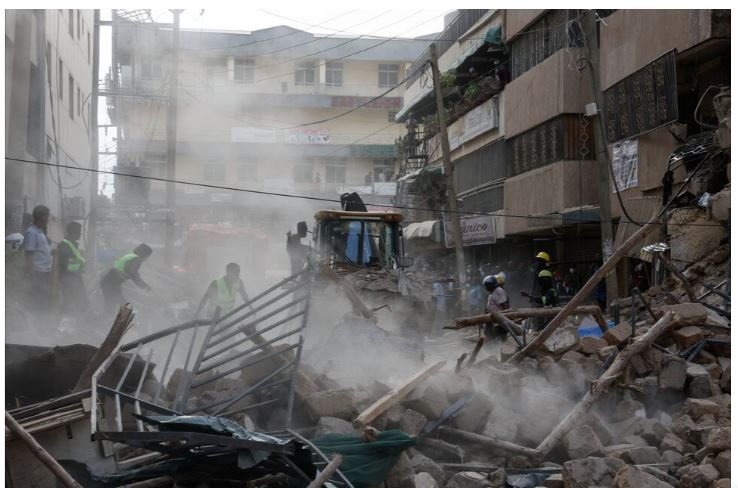
Development Diaries reports that six people died and five others were rushed to Imara Daima Hospital after the upper section of an eight-storey building under construction collapsed along Mombasa Road in Syokimau, south-east of Nairobi last Friday.
Assistant Inspector-General of Police Duncan Ochieng, who leads disaster management, confirmed the deaths, while the Kenya Red Cross reported the collapse from the scene, with the tragedy coming less than a month after another building collapsed in Eastleigh, killing at least eight people.
These are not isolated accidents, as 100 buildings have collapsed in Kenya over the past 30 years, more than 40 people have died in the last five years alone, and inspections by the National Construction Authority (NCA) have uncovered widespread non-compliance with construction standards.
Kenya has a regulator responsible for the construction industry, county authorities responsible for development control and a workplace safety inspectorate.
While these institutions have existed throughout the years in which buildings have collapsed, inspections appear not to be producing enough consequences to stop unsafe construction.
And when an inspection identifies non-compliance but does not lead to a stop-work order, prosecution or the deregistration of a contractor, regulation becomes little more than paperwork.
The deaths also expose the human cost of a construction industry where many workers survive on casual daily wages, often without written contracts, insurance or registration with the National Social Security Fund.
Article 26 of Kenya’s constitution protects the right to life, while Article 43 guarantees rights to accessible and adequate housing and the highest attainable standard of health.
Those protections mean little to workers sent into unsafe sites or residents who have no way of knowing whether the buildings around them meet safety standards.
The Occupational Safety and Health Act 2007 places duties on those responsible for workplaces, while the Work Injury Benefits Act 2007 provides for compensation when workers are injured or killed in the course of employment.
However, families may struggle to claim these benefits when a deceased worker was never formally employed.
For many households, the consequences will fall heavily on women and children who depended on the deceased workers’ daily earnings, as widows and other dependants may be asked to produce employment records that were never issued, while rural families waiting for remittances from relatives working in Nairobi may not even know where to begin seeking answers.
The danger also extends to tenants and buyers living in buildings that have not collapsed but may have been constructed with the same disregard for safety.
Residents should be able to report unregistered or visibly unsafe construction sites through the NCA’s public reporting channel and retain the reference numbers for their complaints.
Civil society organisations and journalists can use the Access to Information Act 2016 to demand records of stop-work orders, prosecutions and contractors deregistered in 2024, 2025 and 2026.
In Syokimau, residents should also press the Nairobi City County Assembly to summon the Director of Development Control and demand the approval file for the collapsed building.
That scrutiny must also extend to the agencies expected to enforce construction standards. So the NCA should publish, within 45 days, a register of sites found non-compliant across Nairobi County in the past 24 months, showing the enforcement action taken against each.
The same transparency is needed over the fate of the workers who died in Syokimau. The Occupational Safety Directorate should disclose the employment status of workers on the Syokimau site and clarify whether compensation claims have been opened for the deceased, while the Director of Public Prosecutions should publish the outcomes of cases arising from building collapses over the past five years, including the number of prosecutions and convictions.
Kenya needs regulators whose warnings can stop construction, prosecutors who pursue those responsible and county officials who can account for the approvals they issue.
Until that happens, developers may continue to treat safety violations as a cost of doing business, while workers, tenants and their families carry the risk.
Photo source: Reuters/Monicah Mwangi

