


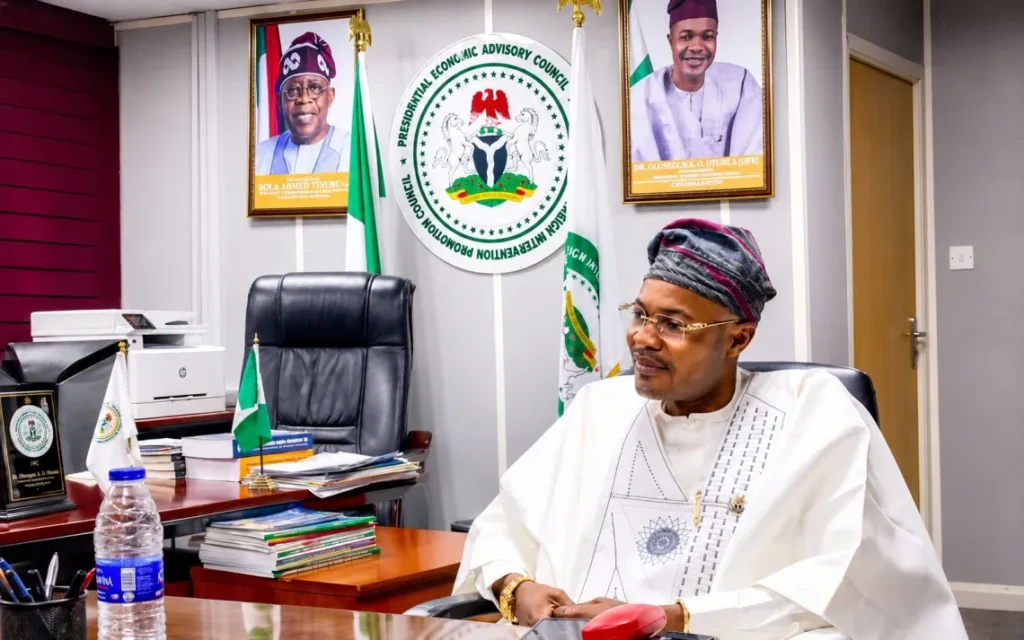
Ghost agencies appearing in Nigeria’s national budget should worry every taxpayer because budgets are supposed to tell citizens where public money will go, not leave them wondering whether the institutions receiving that money actually exist.
Development Diaries reports that the presidency has denied the existence of the Presidential Foreign Intervention Promotion Council (PFIPC), even though the same agency appeared in the 2026 Appropriation Act with a budget allocation of about N1.3 billion.
The controversy followed revelations that Prince Adeniyi Adeyemi Mathew allegedly operated under the agency’s name, hosted foreign ambassadors, maintained offices within the Federal Secretariat in Abuja, opened multiple bank accounts, including one with the Central Bank of Nigeria (CBN), and presented himself as the council’s Director-General before police investigations concluded that the agency never legally existed.
The contradiction has moved beyond a criminal investigation into one of Nigeria’s biggest governance questions this year.
If the presidency says the agency never existed, Nigerians are entitled to know how a non-existent institution found its way into a budget passed by the National Assembly and signed into law by President Bola Tinubu.
Several facts are no longer in dispute, as police investigators concluded that Adeyemi allegedly forged appointment letters and other official documents, falsely presented himself as a presidential appointee and used fake government agencies to open dozens of bank accounts.
The presidency has also insisted that it alerted security agencies about him as far back as October 2025 after the Ministry of Foreign Affairs raised concerns over a meeting he convened with foreign ambassadors.
Those facts may explain the criminal allegations against Adeyemi, but they do not explain the budget.
That is the question refusing to disappear because budgets do not write themselves, and every line in Nigeria’s Appropriation Act passes through ministries, the Budget Office, the Federal Executive Council, the National Assembly and finally the president before becoming law.
The PFIPC’s N1.3 billion allocation survived every one of those institutional checkpoints before appearing under the presidency in the 2026 Appropriation Act, leaving Nigerians with a legitimate question about who saw it, who approved it or who simply looked the other way.
The allegations against Adeyemi do not explain who inserted a non-existent agency into the national budget.
That question deserves an answer because it concerns public finance rather than personal reputation. A witness can be unreliable and still ask a legitimate question. Dismissing the question because of the person asking it does not make the contradiction disappear.
The presidency has understandably focused on showing that Adeyemi allegedly impersonated government and forged official documents. That is an important part of the story. The missing part is how an agency the presidency now says did not exist appeared inside government’s own financial document.
The same contradiction extends beyond the budget, with reports indicating that the agency operated from the Federal Secretariat, maintained an official-looking website, ran social media accounts, opened numerous bank accounts and even hosted ambassadors who believed they were attending an official government engagement.
Government offices are not usually rented out like party halls where anyone can simply walk in, print a signboard and begin receiving diplomats.
The CBN account raises similar questions, as police say the account was opened using forged documents presented through the Office of the Accountant-General of the Federation.
If that is true, Nigerians deserve to know how those verification processes failed. Every institutional weakness exposed today becomes tomorrow’s manual for the next fraudster unless it is properly addressed.
The controversy also exposes weaknesses in Nigeria’s budget process. The country has repeatedly battled reports of ghost workers, duplicated projects and questionable budget insertions over the years.
A ghost agency now joining that conversation is rather like discovering someone reserved a seat at the family dining table for an invisible uncle and everyone politely served him food without asking his surname.
Behind the humour lies a serious governance problem. Every naira allocated to a non-existent institution is money unavailable for schools, hospitals, rural roads or primary healthcare.
The implications extend beyond this particular case because public confidence in government depends largely on whether official records can be trusted. Citizens should never have to compare the presidency’s public statements with the Appropriation Act just to determine whether a government agency exists.
The legal questions are equally important. Nigeria’s constitution permits withdrawals from the Consolidated Revenue Fund (CRF) only in accordance with an Appropriation Act. The Fiscal Responsibility Act also places responsibility on public institutions to ensure accuracy during budget preparation.
If an agency that allegedly never existed appeared in the national budget, the issue extends beyond criminal impersonation into public financial accountability.
The police investigation into Adeyemi should therefore continue without interference, but it cannot become a substitute for investigating how PFIPC entered the budget in the first place. Those are two separate accountability questions requiring two separate investigations.
Women, children and low-income communities often pay the highest price whenever public money is diverted or poorly managed. The N1.3 billion reportedly allocated to a non-existent agency could have funded primary healthcare centres, maternal health programmes, classrooms or rural infrastructure that directly affect millions of Nigerians.
Citizens also have responsibilities beyond following the courtroom drama. Nigerians should use the Freedom of Information Act to request the documents supporting the PFIPC budget allocation, including which office submitted it, who approved it and what legal instrument established the agency.
The National Assembly also owes Nigerians answers because its constitutional responsibility extends beyond approving budgets to ensuring that every appropriation has a lawful basis. Lawmakers should immediately investigate how the allocation entered the budget and invite every institution involved in preparing the presidency’s submissions to publicly explain what happened.
The biggest question is whether Nigeria’s public institutions can convincingly explain how a government says an agency never existed while its national budget says otherwise. Citizens can forgive honest mistakes, but budgets are supposed to count money, not imaginary agencies.