




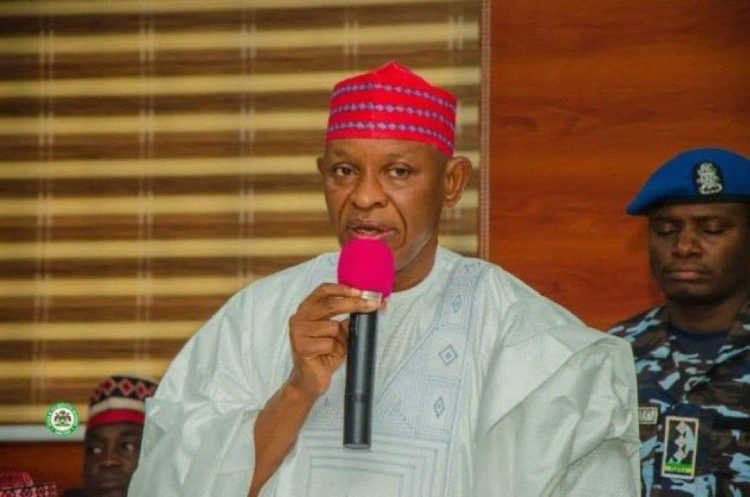
Kano State, northwest Nigeria, has spent N1.5 billion on a mass wedding programme meant to help people who cannot afford marriage, but one of the men who benefited from this year’s scheme already had two wives.
Development Diaries reports that 1,500 couples were married under the Kano State government’s Auren Gata programme last weekend, with each beneficiary receiving a package valued at about one million naira covering furniture, food, dowry support and business capital.
The two men whose stories now sit at the centre of the programme’s accountability question could hardly have arrived there from more different places.
Haruna Bashir lost his first wife and six children in an attack earlier this year, and the Commander-General of the Kano State Hisbah Board, Sheikh Aminu Daurawa, said Bashir had withdrawn from people since the tragedy and was only gradually returning to normal life.
Speaking after his remarriage, Bashir described what the loss had done to him and said he would accept hunger if he could live without fear.
‘If we are being protected, and left with hunger, we will rely on what God makes available for us to eat, even if it is mere corn, but we are burdened by insecurity’, he said.
Another beneficiary, Dantani Aruba, described a very different experience in a video recorded by NewsCentralTV, saying he had just married a third wife and was happy about it.
Both men passed through the same Hisbah screening and benefited from the same N1.5 billion public programme, which means the state has used the same intervention to respond to a man rebuilding his life after losing his family and to another man adding a third wife to an existing household.
The 2026 programme rules allowed beneficiaries in polygamous marriages in accordance with Islamic practice, so Aruba did not necessarily break any rule by receiving the package.
But the problem lies in the rule itself and in what it says about who the programme is designed to help.
Auren Gata was introduced during former governor Rabiu Kwankwaso’s second tenure in 2011 and continued under Abdullahi Ganduje, whose administration married off 1,520 divorcees in 2017.
The current governor, Abba Yusuf, has now continued the programme, which the government says has supported more than 10,000 couples who could not otherwise afford marriage.
The programme has also spread beyond Kano, with states including Kaduna, Sokoto, Zamfara, Katsina, Borno, Jigawa and Yobe organising and financing mass weddings involving widows, divorcees and unmarried women over the years.
Meanwhile, the 2026 spending needs to be viewed in exact figures. Governor Yusuf said the state committed more than N1.5 billion to medical screening, dowry, furniture and other items, with each couple receiving beds, mattresses, bed sheets, pillows, wardrobes and food items, while each bride received N100,000 as seed capital and each groom received N100,000 towards dowry.
The state therefore spent roughly one million naira on each of 1,500 couples, and most of that support went directly into household consumption.
Kano’s own budget figures raise a question about what else that money could have supported. The state’s 2026 first-quarter budget implementation report contained two specific allocations for out-of-school children, including N135 million for programmes targeting out-of-school girls, children and married adolescent girls through the Kano State Agency for Mass Education and N46.3 million for 20 mobile learning centres.
Neither allocation had been disbursed or spent by the end of the first quarter. Together, the two lines amounted to roughly 12 percent of the wedding programme’s N1.5 billion expenditure.
The comparison does not mean Kano’s N432.4 billion education allocation for 2026 should be ignored, as education accounts for 29.4 percent of the state’s N1.477 trillion budget, which is above the UNESCO benchmark, and the government can reasonably point to that commitment when defending its priorities.
The education gap is especially significant in Kano because a UNICEF education consultant disclosed in May that Kano, Jigawa and Katsina together account for almost 30 percent of Nigeria’s 18.3 million out-of-school children.
The government’s justification for Auren Gata has always centred on affordability. High bride prices and expensive wedding expectations can leave widows, divorcees and other women unable to remarry, while the state says its support reduces that financial burden and helps promote stable households.
That logic is also reflected in the screening process, with prospective grooms having to demonstrate that they have a source of livelihood and accommodation before they are cleared.
The same requirement creates a contradiction when the state finances a man’s third simultaneous marriage. If a groom must demonstrate that he can earn a living and provide accommodation, the state has already established that he can maintain a household.
Funding another marriage for him therefore raises the question of whether public money is reaching the people the programme was created to support.
Kano has not published how many of the 1,500 beneficiaries were entering second or subsequent marriages, or what share of the N1.5 billion went to those households.
Without that information, citizens cannot tell how much of the programme reached first-time couples, widows and divorcees who might otherwise struggle to marry.
The household consequences also deserve attention because adding another wife to a household does not increase the income available to that household. The N100,000 seed capital given to the new bride may support a small business, but the state has not published evidence showing whether that investment produces enough income to offset the additional demands on the household.
The programme also carries a political advantage that ordinary social programmes rarely enjoy, as 15 hundred couples can be counted, photographed and presented as beneficiaries, while the effect of a girls’ education programme may take years to become visible.
The religious dimension adds another layer of political protection. The programme was developed by the state government and Hisbah in response to concerns about divorce and what officials described as social decay, while Islamic scholars and traditional rulers have publicly supported the initiative.
Governor Yusuf has acknowledged the Kano State Council of Emirs, including Emir Muhammadu Sanusi II and the emirs of Rano, Karaye and Gaya, and thanked Islamic scholars who travelled to counsel the couples.
That support gives the programme considerable moral authority, which can make criticism of the spending difficult because questioning the appropriation can quickly be interpreted as questioning marriage, religion or traditional institutions.
The programme’s own rules, however, do not make it exclusively Muslim. The Hisbah Board has said qualified couples can participate regardless of religion, and three Christian couples took part in the October 2023 edition.
The gender implications are harder to dismiss because the screening requirements are not applied equally to men and women. Under the programme’s earlier rules, brides were subjected to chastity and background checks, while men were screened for income and accommodation.
Kano has also not published whether existing wives were notified during the screening process or whether their views formed part of the assessment.
The refund condition raises another concern. The Hisbah Commander-General has said anyone who abuses the programme or divorces the wife would be compelled to refund the items provided by the government.
Nigeria’s legal obligations also require the state to pay attention to who benefits and who is protected. The country has ratified the Convention on the Elimination of All Forms of Discrimination Against Women, the Convention on the Rights of the Child and the Maputo Protocol, while Section 18 of the 1999 constitution directs the state towards free, compulsory and universal primary education.
Citizens should ask the Kano State Hisbah Board how many of the 1,500 grooms in the 2026 cohort were entering a second, third or subsequent simultaneous marriage and how much of the N1.5 billion was spent on those placements.
They should also ask whether existing wives were notified during screening, request the age-verification protocol and publish the response or the refusal.
Members of the Kano State House of Assembly should explain why the N135 million allocation for programmes targeting out-of-school girls, children and married adolescent girls remained undisbursed at the end of the first quarter while the wedding programme received more than N1.5 billion.
Women’s organisations should request the number of widows and divorcees on the programme’s waiting list and compare that figure with the number of polygamous placements funded in the same cohort, while beneficiaries should keep records of everything they received because the refund condition may create future liabilities.
As for the Kano State government, it should publish within 30 days the number of polygamous placements in the 2026 cohort, the amount spent on them, beneficiary age data and the standard used to verify consent and eligibility.
The Hisbah Board should then publish the rule that admitted existing polygamous households, identify who approved the change and explain how the rule serves a programme justified by inability to afford marriage.
The Kano State House of Assembly should commission an independent evaluation of the programme since 2011, covering marital survival, household income and the school enrolment of children in beneficiary households before approving further funding, while the Ministry of Women Affairs and Social Development should publish a gender-impact assessment comparing the wedding expenditure.
Auren Gata may have helped thousands of people marry, and Haruna Bashir’s case shows why a state can sometimes intervene in a citizen’s life with compassion.
The same programme can still spend public money in ways that deserve scrutiny when it pays for a third marriage while women and children facing poverty remain outside the queue.