



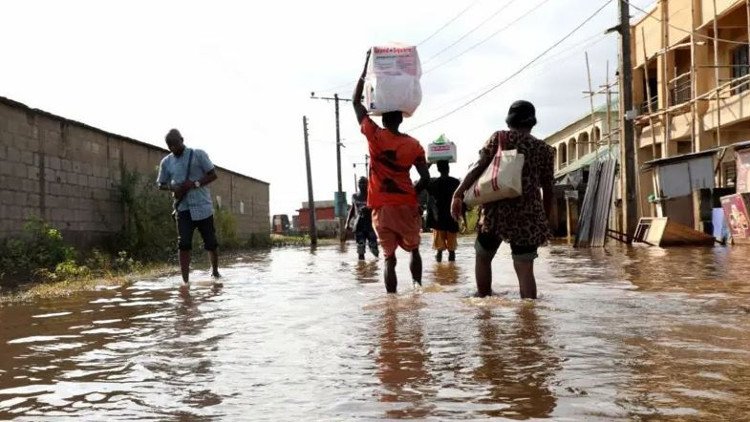
The latest flooding in Lagos has revived an old question about whether the city is managing floods or simply managing public explanations after the damage has already been done.
Development Diaries reports that Lagos State Governor Babajide Sanwo-Olu and the Minister of Works, David Umahi, have dismissed claims that the Lagos-Calabar Coastal Highway caused the latest flooding, insisting instead that Lagos’s coastal geography and poor waste disposal remain the major causes.
Whether the highway contributed to the flooding deserves investigation, but it should not distract from the larger accountability issue. Lagos flooded long before the Coastal Highway was conceived, and unless the city fixes the systems designed to control floodwater, it will continue flooding long after the argument over one road has disappeared.
Every rainy season, streets vanish beneath water, homes are submerged, businesses shut down, traffic grinds to a halt and residents begin to share videos of people paddling through roads that looked perfectly normal only hours earlier.
No single project has ever explained Lagos’s flood problem, as poorly maintained drainage channels, construction on wetlands, blocked waterways, uncontrolled waste disposal, rapid urbanisation and rising sea levels have all combined to make flooding a predictable part of life in the city. While indiscriminate waste disposal contributes to the problem, it cannot explain why drains meant to carry stormwater away are so often blocked, neglected or missing altogether in many communities.
That is why citizens should be asking a different question. Does Lagos have a publicly available and adequately funded flood management plan that people can actually monitor?
A city that floods almost every year should already know which drainage channels require routine clearing, which communities face the highest risks, how much has been budgeted for maintenance and who should answer when that work is not carried out.
The Lagos State Ministry of the Environment and Water Resources oversees drainage infrastructure across the state, while agencies responsible for environmental regulation and construction approvals must ensure that major projects do not increase flood risks.
The Federal Ministry of Works also owes Nigerians evidence supporting its position by making the environmental and drainage impact assessment for the Lagos-Calabar Coastal Highway publicly available.
Nigeria’s constitution places a responsibility on government to promote citizens’ welfare and protect the environment, but every flooded home, school forced to close, business that loses stock and outbreak of waterborne disease raises legitimate questions about whether government is fulfilling those responsibilities.
The impact is also far from equal. Residents of affluent neighbourhoods may lose expensive vehicles and property, but many have insurance, temporary accommodation and the financial resources to recover.
Families living in Makoko, Ajegunle and other low-lying communities often lose everything because floodwater enters homes built with few protections and destroys the small businesses on which household incomes depend, while women running home-based enterprises frequently watch both their homes and livelihoods disappear beneath the same floodwater.
Urban planning and environmental experts have repeatedly argued that Lagos has become better at explaining floods than preventing them, with every rainy season bringing official statements, inspections and assurances, but residents still struggle to find a publicly accessible drainage maintenance plan showing what work has been completed, what remains outstanding and who should be held accountable when the same communities flood year after year.
Citizens should therefore request drainage maps, maintenance schedules and records of completed drainage projects within their local government areas while documenting blocked drainage channels and reporting them through official state channels.
That information would make it easier to determine whether flooding resulted from unusually heavy rainfall or from infrastructure that should already have been maintained.
For its part, the government of Lagos State should publish a comprehensive flood management plan covering drainage infrastructure, annual maintenance budgets, implementation records, early warning systems and support for affected communities.
As for the Federal Ministry of Works, it should also release the environmental and drainage impact assessment for the Lagos-Calabar Coastal Highway so public debate is guided by evidence rather than competing official statements.
Photo source: Getty Images