



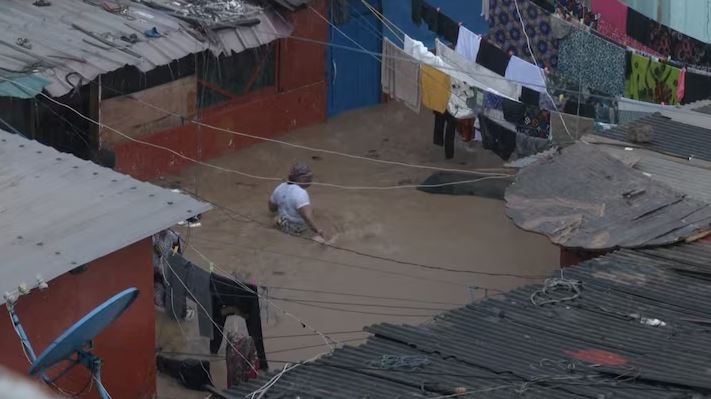
Every rainy season, Accra buries more cars, loses more lives and repeats more promises because the city’s flood disaster has become less a natural emergency than a governance routine.
Development Diaries reports that at least 13 people have died after torrential rains submerged homes, swept away vehicles and cut off major roads across Ghana’s capital, with weather authorities warning that another storm could worsen the crisis.
Among the victims was a female trader who was swept away near Tema Community One Market and has yet to be found, while dramatic images showed residents swimming through neck-deep water to rescue neighbours and vehicles disappearing beneath floodwaters around Airport Roundabout.
As emergency agencies continue rescue operations, government officials have again pledged to strengthen disaster preparedness and flood mitigation.
Accra has lived through this story too many times. In 2015, more than 200 people died after floodwaters triggered an explosion at a petrol station near Kwame Nkrumah Circle. Floods submerged entire neighbourhoods again in 2021, while the Akosombo Dam spill displaced about 26,000 people in 2023.
After every disaster, the evidence hardly changes, as the drains are still blocked, waterways are still occupied by buildings, planning laws are still poorly enforced, and the next promise to fix everything is already on its way.
President John Mahama is right to say climate change is making rainfall more intense across West Africa. About 140 millimetres of rain reportedly fell over Accra in a single day, more than double the city’s highest daily rainfall last year.
But floods kill people only when cities are unable to manage them, and that is where governance begins.
The Interior Minister has assured Parliament that the National Disaster Management Organisation (NADMO), the Ghana Armed Forces, the Police Service, the Fire Service and other emergency agencies remain on the ground supporting rescue and relief operations. Government has also renewed its commitment to improving flood preparedness and mitigation.
The difficulty is that Ghanaians have heard this commitment after virtually every major flood. What remains missing is a publicly available, funded timetable showing which drainage channels will be cleared, which illegal structures on waterways will be demolished, who is responsible for doing so, how much has been budgeted, and when citizens should expect the work to be completed.
The law already assigns responsibility for preventing this outcome to the Accra Metropolitan Assembly, which manages urban drainage, the Water Resources Commission, which regulates waterways, the Ministry of Local Government, which oversees metropolitan assemblies, and the Environmental Protection Agency, which is empowered to act against illegal developments on flood plains.
The accountability gap lies in the absence of any transparent enforcement record showing that the aforementioned institutions have used those powers consistently enough to stop the same disaster from recurring year after year.
The same accountability gap extends to disaster preparedness. NADMO receives annual public funding and is highly visible once floods begin, but far less is publicly known about its investment in prevention, infrastructure inspections, flood-risk mapping or support for enforcement activities before emergencies happen.
The burden of these failures is not shared equally. Women who trade in open markets and roadside stalls often occupy the lowest ground where floodwaters arrive first. The female trader swept away near Tema Community One Market represents thousands of women whose daily livelihoods place them directly in known flood-risk locations without effective early warning systems or evacuation plans.
Persons with physical disabilities face even greater dangers because damaged roads and rapidly rising floodwaters make evacuation far more difficult. Many low-income families living in basement apartments and informal settlements also experience the highest flood exposure while having the least financial protection to recover after disasters.
Citizens need not wait for another rainy season before demanding answers. District assemblies should be required to make available the latest drainage inspection reports for every community, alongside the status of rehabilitation projects funded through recent public budgets.
The Accra Metropolitan Assembly should also publish a quarterly drainage accountability report identifying blocked drainage channels community by community, indicating when each was last cleared, how much the work cost and when the next maintenance is scheduled.
At the same time, the Ghana Meteorological Authority should establish an accessible WhatsApp-based flash flood warning system covering Accra’s highest-risk communities before the next heavy rainfall arrives.
Climate change may determine how hard the rain falls. Whether that rain becomes another national tragedy depends on whether government finally decides to govern flood prevention with the same urgency it governs flood response.
Photo source: Reuters