




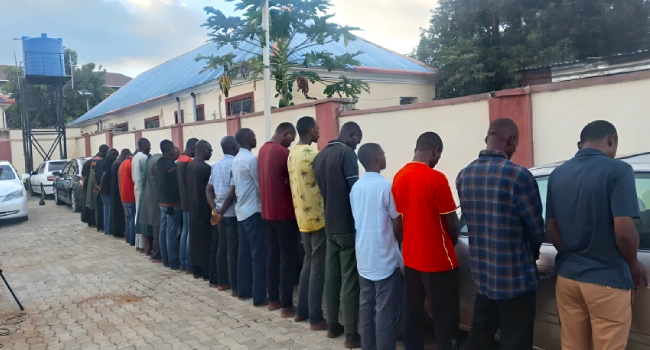
37 people died in the custody of the Nigeria Security and Civil Defence Corps (NSCDC) in Minna, Niger State, after being arrested over suspected illegal mining, turning an enforcement operation into a test of whether the Nigerian state can protect the people it takes into custody.
Development Diaries reports that the detainees were arrested during NSCDC operations around M.I. Wushishi and Lukoto in the north-central state on 15 and 16 September, with the deaths reportedly discovered in the early hours of 17 September.
Operatives of the NSCDC initially described the deaths as following a suspected disease outbreak, while the Niger State governor later said that the corps was also examining possible suffocation linked to overcrowding and exposure to hazardous substances associated with mining.
Reports said 67 people had been held in the facility before 37 died, while survivors described a poorly ventilated and overcrowded cell, with the federal government since suspending the Niger State commandant of the NSCDC and 20 other officers and constituting a ten-member independent committee to investigate the arrests, detention conditions and deaths.
The cause of death should now be established through evidence rather than competing versions of what may have happened.
The NSCDC’s first reference to a suspected disease outbreak cannot by itself settle the matter, just as survivor accounts about overcrowding and suffocation cannot be treated as a final medical finding.
The proper response is forensic evidence, medical records, witness accounts, detention records and a clear reconstruction of what happened between the arrests and the discovery of the bodies.
It is understood that the federal investigation has two weeks to complete its work, making the quality and transparency of that process especially important.
There is also a basic custodial question that should not disappear beneath the debate over illegal mining. Once the state arrests someone, responsibility for that person’s safety shifts heavily onto the state, regardless of what the person is suspected of doing.
The Administration of Criminal Justice Act 2015 already provides a mechanism for checking what happens inside places of detention. Section 34 requires the Chief Magistrate or a designated magistrate to inspect police stations and other places of detention within the relevant jurisdiction at least once every month, while officials in agencies authorised to make arrests are required to make arrest and bail records available during such inspections.
For federal agencies authorised to make arrests, the Act provides for the High Court with jurisdiction to visit the detention facilities. So the question is whether safeguards were activated, when the facility was last inspected and what the inspection record says about its capacity and conditions.
The incident also exposes a familiar weakness in the way illegal mining enforcement is often carried out. The people found at mining sites are the easiest part of the chain to arrest, while the people financing operations, controlling access to mineral sites and profiting from the trade can remain much further from the enforcement spotlight.
The Nigerian Bar Association (NBA) has called for the owners and financiers behind illegal mining in Niger State to be investigated, and that line of inquiry deserves attention alongside the arrests of people found at mining sites.
That does not excuse illegal mining or reduce the damage it can cause to farmland, communities and public revenue. It simply means that enforcement should follow the money and the organisers as well as the people doing the digging, while treating everyone in custody according to the law.
The people responsible for answering what happened in Minna are the NSCDC, the Ministry of Interior, the Nigeria Police Force, the Niger State judiciary, the National Human Rights Commission (NHRC), the Ministry of Solid Minerals Development, and the Mining Cadastre Office.
Each institution has a different piece of the story, and each should put that piece into the public record rather than allowing one investigation to become a substitute for another.
From a human rights perspective, Section 33 of the constitution protects the right to life, Section 34 protects the dignity of the human person and prohibits torture or inhuman or degrading treatment, while Section 35 protects the liberty of arrested persons.
The Anti-Torture Act 2017 also places duties on the government to protect suspects and detainees from physical harm, force, violence and other prohibited treatment, while making commanding officers liable as accessories where an act, omission or negligence contributes to torture by subordinates.
Where children were among those detained, the legal protections should be activated, with the Child Rights Act providing that detention pending trial should be used only as a last resort and for the shortest possible period, with alternative measures preferred where possible, while children in detention are entitled to appropriate care, protection and medical and other assistance.
Reports have identified minors among those who died, making the investigation responsible for establishing their ages, circumstances of arrest and treatment in custody.
Families should not have to piece together what happened from photographs, rumours and competing official statements. They should receive the identities of the deceased, information on the circumstances of their arrest and detention, medical findings and a clear explanation of what happened to their relatives.
Citizens can seek detention records and inspection reports through the Freedom of Information Act, documenting the experiences of affected families and asking their representatives to push for enforceable custodial standards.
For the NHRC, it can independently investigate the human rights dimensions, and the judiciary can ensure the detention-inspection provisions of the criminal justice framework are actually used.
The committee’s report should leave a public record showing who was arrested, why they were arrested, where they were held, how many people were in the cell, what medical attention they received, who inspected the facility, what happened during the final hours and who bears responsibility for the failures that allowed 37 people to leave a mining site alive and never return home.
Photo source: Channels TV