




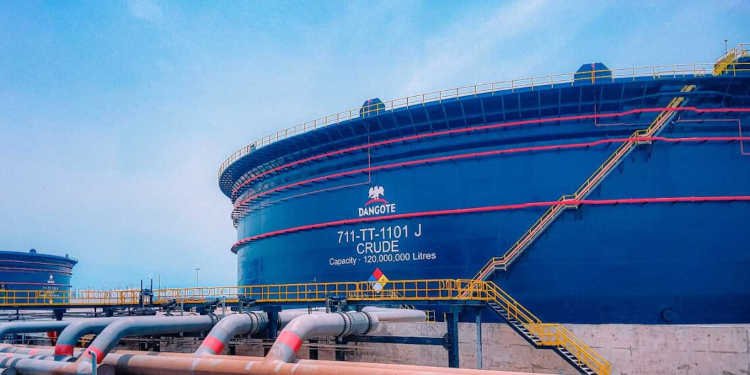
For N5,250, ordinary Nigerians can now own a piece of Dangote Refinery, giving the company fresh capital, a wider shareholder base and a public market valuation while leaving control firmly in the hands of its founder.
Something unusual is unfolding around Nigeria’s biggest refinery as drivers, cooks, traders and civil servants line up to buy at least ten shares in a company still overwhelmingly controlled by Aliko Dangote, and the enthusiasm has been expressed in the most Nigerian way possible, through memes, jokes and imaginary board meetings.
In fact, one X user asked for a house near the refinery so he could watch ‘our company’ around the clock, while a video showed a new shareholder confronting a dirty fuel tanker with the words, ‘Dangote, we need a board meeting’.
Comedian Sabinus has also turned the new ownership craze into skits featuring ten-share owners demanding briefings from management, while Reuters reported that demand was intense enough on the first day to push Bamboo’s traffic to ten times its normal level within 30 minutes.
The jokes capture how Nigerians are excited about owning a piece of a major industrial project and, for many first-time investors, the initial public offering (IPO) offers a new sense of participation in a company they have mostly experienced as a name on petrol stations and fuel tankers.
The company is gaining something too, and that side of the transaction deserves as much attention as the excitement over becoming a shareholder. The offer puts 4.1 billion new shares on the market at N525 each, raising about N2.15 trillion, or roughly $1.6 billion, with ten shares costing N5,250.
Those shares amount to about 3.3 percent of the company, and based on the prospectus figures reported by Nairametrics, Dangote’s beneficial interest would fall from about 87.3 percent to 84.34 percent, while the Nigerian National Petroleum Company (NNPC) Limited’s stake would fall from 6.8 percent to about 6.6 percent.
Even the idea of a mass retail takeover needs some arithmetic, with a Mauritius-based vehicle, Pan-African Refinery Investment SPV, already committing $400 million, taking roughly a quarter of the IPO shares. That leaves the rest of the market with a stake of about 2.5 percent of the company.
So when new shareholders joke about ‘our refinery’, the joke has a numerical footnote because they do own a stake in it, while the overwhelming share remains with the existing controlling interests.
In other words, for a ten-share investor, that stake offers almost no individual influence over corporate decisions, even as the IPO gives ordinary Nigerians access to the market and a place on the shareholder register, while control remains with the holder of more than 84 percent of the company.
There are legitimate reasons for keeping that level of control. It protects a strategic business from an unwanted takeover, gives the founder room to pursue long-term plans and signals that he remains heavily invested in the company’s future. It also leaves the company with options for future expansion, including Dangote’s stated ambition to list in the United States within the next three or four years.
The trade-off is that wider ownership does not necessarily mean wider corporate power, as mass ownership can spread economic participation without giving individual shareholders much influence over how the company is run. Saudi Aramco’s 2019 IPO offers a useful example, attracting 4.9 million retail applicants for a 1.5 percent stake while the Saudi state retained control.
Nigerians can therefore gain access to ownership while Dangote retains control, with the company also gaining from bringing a wider pool of Nigerians onto its shareholder register.
That brings the conversation to what a public listing actually gives a company.
The IPO immediately raises about $1.6 billion, establishes a public market price for the shares and creates a much larger shareholder register. Listing also turns those shares into a form of corporate currency because a publicly traded company can, subject to shareholder approval, regulatory requirements and competition rules, potentially use shares in acquisitions, raise additional capital through rights issues, offer shares as part of employee compensation and borrow against a more visible market valuation.
There is no credible evidence that Dangote Refinery plans to use its new listing to fund acquisitions through shares, so any discussion of that possibility should remain hypothetical.
But the wider Dangote Group already understands how such corporate tools work. In 2023, Dangote Sugar proposed absorbing NASCON and Dangote Rice through share swaps, although the Securities and Exchange Commission (SEC) later suspended the deal. At the IPO launch, Dangote also said he planned to list every company he operates.
The IPO therefore has significance beyond the N2.15 trillion it is designed to raise. It gives the refinery capital, a public valuation and a liquid share that can become useful in future corporate transactions, although what the company eventually does with those tools will depend on decisions that have not been announced.
There is also a curious dilution paradox because Dangote is giving up part of his ownership, while the company gains new capital, a public valuation, greater visibility with lenders and investors, more liquidity for its shares and additional options for raising and deploying capital.
The controlling shareholder’s smaller percentage can therefore sit alongside a more valuable and more flexible institution. Bloomberg estimates that the listing could add about $23 billion to Dangote’s net worth, illustrating how a smaller percentage of a more valuable company can produce a very different outcome from simply saying that the founder has been diluted.
For the new shareholders, the picture is equally worth separating from the excitement. Nigerians gain access to ownership and a stake in a company that could expand significantly, while the refinery gains capital and a broader investor base. What remains unclear is how much practical influence those new owners can exercise once the memes stop and the shareholder meetings begin.
Can a ten-share owner do anything beyond demand a board meeting on social media? Can employees who become shareholders use that ownership to influence corporate culture? Could thousands of small shareholders eventually organise around common interests?
Those are the questions I will examine next.
Did you buy the shares? Did you decide not to? Tell me why. I will draw on your responses in Part Two.
Editor’s note: Development Diaries does not provide investment advice, and nothing in this series is a recommendation to buy or sell any security.