


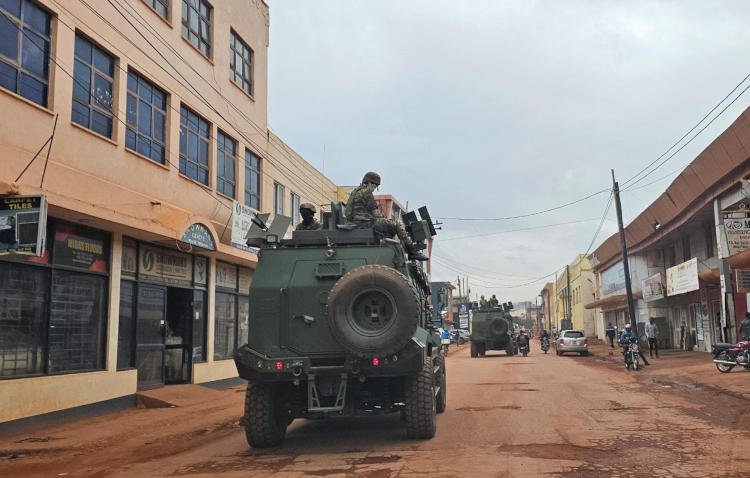
Uganda’s legal framework for regulating the media collapsed the moment a military officer’s social media post became more powerful than the country’s communications regulator.
Development Diaries reports that Uganda’s Chief of Defence Forces, General Muhoozi Kainerugaba, recently announced on X that NTV Uganda and the Daily Monitor would be shut down.
Within hours, armed and masked soldiers had surrounded Nation Media Group Uganda’s headquarters in Namuwongo and its broadcast facilities at the Kampala Serena International Conference Centre, forcing NTV Uganda, Spark TV, KFM, Dembe FM, the Daily Monitor and The EastAfrican off air.
President Yoweri Museveni later confirmed that he authorised the operation.
What happened that morning raises a far more troubling question about whether the rule of law still determines who can shut down a broadcaster in Uganda, or whether a senior military officer’s social media account now carries greater authority than the country’s own laws and institutions.
Nation Media Group Uganda is East and Central Africa’s largest independent media house, employing more than 500 people and operating newspapers, television stations and radio stations that millions of Ugandans depend on for news.
Outside Kampala, where radio remains the primary source of information, many communities suddenly lost one of their few independent sources of reporting on local government, health services and public affairs.
General Muhoozi justified the shutdown by accusing the media house of its coverage of the arrest of Kampala Lord Mayor Erias Lukwago, who also serves as one of opposition figure Kizza Besigye’s defence lawyers.
Besigye himself has remained in detention for more than 600 days after his controversial arrest in Kenya in 2024.
Viewed separately, these may appear to be unrelated developments. However, taken together, they describe a consistent pattern in which political opposition is detained, lawyers defending that opposition come under pressure, and the journalists documenting both become the next target.
The institutional response made the situation even more revealing. Uganda’s Communications Commission is the statutory body empowered under the Uganda Communications Act to regulate broadcasters.
But while soldiers occupied the premises of a licenced media organisation, the commission merely announced that it had ‘noted the circumstances’ and was consulting with government agencies. It neither asserted its regulatory authority nor publicly challenged the legality of the military operation.
Uganda’s constitution guarantees freedom of expression and freedom of the press under Article 29, while the Uganda Communications Act clearly assigns responsibility for regulating broadcasters to the Uganda Communications Commission rather than the military.
The operation against Nation Media Group therefore raises questions about press freedom and whether constitutional guarantees and statutory institutions retain practical authority whenever they collide with executive power.
The consequences also extend beyond newsrooms. KFM and Dembe FM serve millions of listeners, particularly women in low-income urban and peri-urban communities who rely on radio for civic information, public health updates and local news in Luganda.
When those stations disappear, the communities that lose access are often those with the fewest alternative sources of independent information. Women journalists working inside those organisations also face heightened professional and personal risks in the aftermath of military intervention, including harassment, intimidation and loss of livelihood.
The Committee to Protect Journalists (CPJ) described the detention of Timothy Kalyegira as another escalation in Uganda’s campaign against independent journalism, while the East Africa Journalists Federation warned that intimidating the media would not solve the country’s political challenges.
Both statements point to the same concern that governments strengthen public confidence by answering scrutiny, not by switching off those asking the questions.
Ugandans can respond by documenting the military closure and submitting formal complaints to the Uganda Human Rights Commission, while media organisations and civil society groups should preserve evidence of the operation for future judicial review.
At the regional level, the East African Community should invoke its commitments to democratic governance and request a formal legal explanation from Uganda’s attorney general identifying the constitutional basis for deploying soldiers to close licenced media organisations.
Uganda’s Communications Commission also owes the public its own legal opinion explaining whether its statutory authority was bypassed and, if so, what that means for every broadcaster still operating in the country.
When governments begin to treat journalism as a security threat instead of a constitutional safeguard, the first casualty is every citizen who depends on independent information to know what those in power are doing in their name.