



A federal agency that does not exist got government office space and N1.3 billion in the 2026 budget, and nobody has explained who put it there.
Development Diaries reports that the Independent Corrupt Practices and Other Related Offences Commission (ICPC) recently uncovered another alleged fake office operating inside the Office of the Secretary to the Government of the Federation (OSGF), days after investigators found that another purported agency had received more than N1.3 billion in the 2026 budget despite the Presidency saying it was never established.
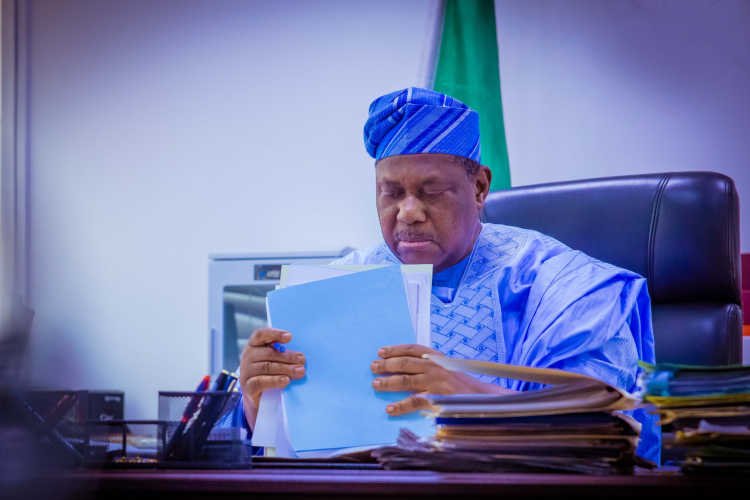
Following the latest discovery, President Bola Tinubu ordered the arrest of Prince George Buchi Nwabueze and suspended three permanent secretaries, M.S. Danjuma, Nadungu Gagare and Richard P. Pheelangwah.
The latest office, identified as the National Brands Development and Made in Nigeria Special Project Office, was allegedly allocated space inside the OSGF without presidential authorisation.
The ICPC said it found the office while investigating the earlier-uncovered Presidential Foreign Intervention Promotion Council, which had received more than N1.3 billion in the 2026 budget before the presidency denied that it ever existed.
The promoter of the second office allegedly operated under several variations of his name, including George Nathan, George Nathan Nwabueze, Hon George Buchi Nwabueze, Prince George Buchi Nwabueze and George Nwabueze.
More troubling, the earlier purported agency also made its way into the national budget, with Adeniyi Adeyemi, who was linked to the earlier case, reportedly saying the arrangement involved promises of future employment for contacts of unnamed officials and had not been completed before his arrest.
He also said that he was surprised to discover that the agency had later appeared in the 2026 budget, further alleging that the Chief of Staff to the President, Femi Gbajabiamila, was behind his appointment and had received money through proxies and demanded more.
But Gbajabiamila denied the allegations when he appeared before the ICPC.
This is where the scandal moves from an office inside the OSGF to the machinery that controls public money.
A federal agency should have an establishment instrument and official records before it receives government accommodation or public funding. That means the Budget Office of the Federation should be able to verify that an agency exists before including it in the Appropriation Bill, while the National Assembly should scrutinise the request against the government’s establishment records maintained by the Office of the Head of the Civil Service of the Federation.
Somebody still needs to explain how an agency without a clear establishment record received N1.3 billion.
Three permanent secretaries have now been suspended over the latest office allocation, but nobody has been publicly identified over the budget allocation that put N1.3 billion behind an agency the presidency says never existed.
That money could have funded services Nigerians actually use.
In the same period, lawmakers in Kano called for urgent action after more than 50 children reportedly died from diphtheria in Rano.
For families already struggling with poor health services, weak schools and inadequate infrastructure, money disappearing into questionable budget lines means fewer resources for services that should already be reaching them.
Section 80 of the Nigerian constitution requires withdrawals from the Consolidated Revenue Fund to follow the procedure prescribed by the National Assembly, while Section 81 governs the estimates presented to the legislature.
The Fiscal Responsibility Act 2007 also requires transparency and accountability in public finance, while the Freedom of Information Act 2011 gives citizens a way to demand the records behind public decisions.
The ICPC deserves credit for uncovering both offices, and President Tinubu’s order for a forensic audit of government processes could help expose the gaps that allowed them to operate.
The investigation now needs to follow the money.
The Budget Office should therefore disclose who processed the N1.3 billion allocation, the authority relied upon, the establishment document submitted and the officials who approved it.
The National Assembly should also explain how the line item passed through its appropriations process.
Citizens and budget transparency organisations can use the Freedom of Information Act to demand the records and compare the 2026 Appropriation Act with the official register of federal agencies.
As for the ICPC, it should publish whether any Budget Office officials are under investigation, while the Auditor-General for the Federation should audit offices operating within the OSGF and publish the findings before the 2027 budget process begins.
The Budget Office should also require every agency seeking public funding to provide its establishment instrument alongside future budget submissions.
Nigeria should not need an anti-corruption investigation to discover that an agency does not exist after finding it inside a government building and inside the national budget.