


South Africa’s decision to temporarily step back from the G20 during the United States’ 2026 leadership has been dressed up as a calm diplomatic pause, but for Africa, it reads more like a warning siren about how global power still works when the stakes are high and the voices are African.
Development Diaries reports that for the first time since South Africa became the continent’s only representative in the G20, it has withdrawn at Washington’s prompting, after months of rising tension and an unmistakable signal from U.S. President Donald Trump, who openly boycotted South Africa’s G20 summit in 2025, making it clear that multilateral respect only applies when it is convenient.
This is bigger than a disagreement between Pretoria and Washington because it raises a blunt question that affects every African household.
Who speaks for 1.4 billion Africans when the world’s most powerful economies are deciding how debt, inflation, climate finance and development money will be shared?
The G20 was created to coordinate global responses to crises that do not respect borders, yet the speed with which Africa’s only seat can be politically sidelined exposes a system where participation is not protected by rules but by the comfort of dominant powers.
There is no firm institutional shield stopping a powerful country from isolating another within the G20, which means multilateralism still operates by mood and muscle rather than principle and fairness.
Africa’s presence in this space rests on one country, not on a guaranteed continental seat, so when South Africa steps back, willingly or under pressure, the entire continent vanishes from the room without a word being spoken.
The decision has been described as rational and temporary, a way to avoid an open clash with the United States, but that logic quietly normalises a dangerous idea that Africa’s seat at the table is optional and can be packed away whenever it makes powerful partners uncomfortable.
Responsibility for this failure does not sit in one place because the G20 itself has refused to institutionalise Africa’s voice, major powers have shown they are willing to bend multilateral norms when it suits them, and African leaders have not collectively pushed hard enough for representation that goes beyond symbolism.
For ordinary Africans, this is not abstract diplomacy happening somewhere far away because when Africa is absent from the G20 table, debt relief terms are negotiated without African realities, climate finance promises bypass frontline communities, and global tax and financial rules are written with little regard for African economies.
Those decisions filter directly into everyday life through weaker health systems, tighter education budgets and fewer resources to protect communities already facing floods, droughts and rising food prices.
Africa makes up more than 17 percent of the world’s population, yet for years it has had just one G20 seat, meaning that decisions affecting the economic rights of 1.4 billion people are often taken with minimal African input, undermining the internationally recognised right to development.
When multilateral spaces shut Africa out, the pain does not land evenly because women feel it first through cuts to health and social services, young people face shrinking job opportunities as trade and investment rules ignore African needs, rural and climate-vulnerable communities lose out on adaptation funds, and persons with disabilities are pushed further to the margins when social protection systems are squeezed.
The uncomfortable truth is that South Africa’s withdrawal may make short-term diplomatic sense, but it exposes a deeper reality that Africa is still negotiating from a position of permission rather than power, and if one president’s displeasure can mute a continent, then Africa’s inclusion was never truly secure.
Africans and civil society cannot afford to watch quietly, as they have a right to ask South Africa’s government to clearly explain what Africa loses by being absent from the G20, and to push leaders across the continent to jointly demand permanent representation in global economic decision-making spaces.
They must also connect these global decisions to local consequences by tracking how G20 outcomes on debt, climate finance and development funding shape national budgets, public services and the cost of living at home.
At the same time, global institutions must stop pretending that ad-hoc inclusion is enough by formally recognising the African Union as a permanent G20 member, resisting political boycotts that weaken collective governance, and engaging Africa as a bloc rather than as isolated national voices.
Development Diaries is watching this development closely because when Africa steps back quietly from global tables, the consequences show up loudly in citizens’ lives, proving that this is not a diplomatic footnote but a test of whether global governance can ever work for Africa instead of merely talking around it.
Until Africans demand better and stronger representation, exclusion will keep being described as temporary, even as inequality quietly becomes permanent.
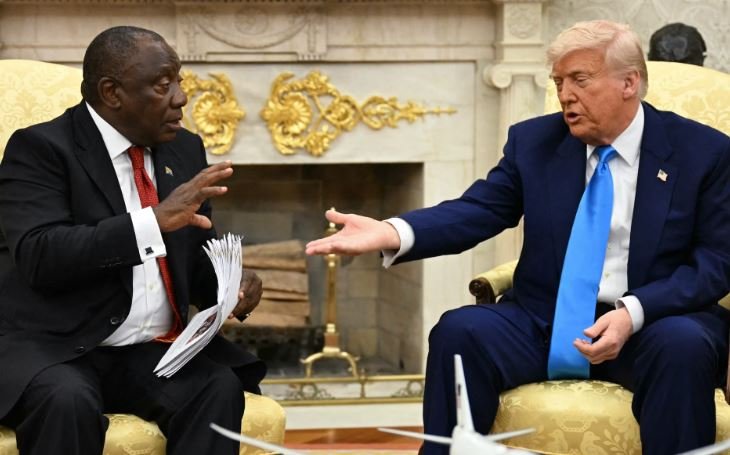
Photo source: Jim Watson/AFP/Getty Images