





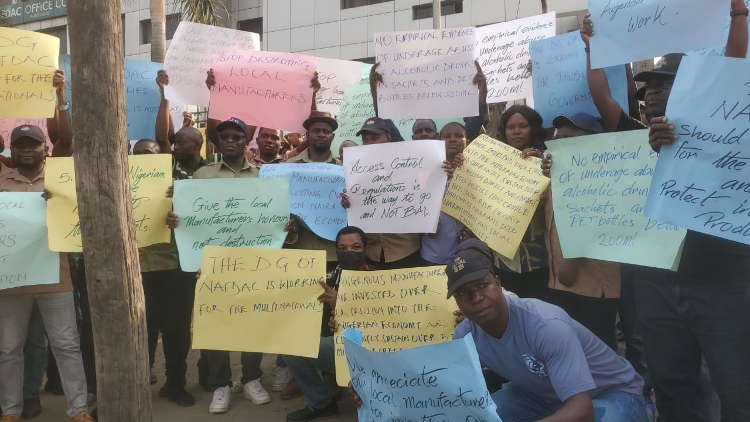
On a weekday morning in Lagos, the usual drama played out like a well-rehearsed street performance of placards up, whistles screaming, chants flying about lost jobs and dying livelihoods, all staged neatly outside NAFDAC’s office as protesters demanded an end to the agency’s enforcement of the sachet alcohol ban.
To anyone passing by, it looked like democracy doing press-ups in the sun, citizens checking state power and workers defending their daily bread.
But Nigerians have lived long enough to know that not every protest is the people speaking; some are power borrowing the people’s voice, renting anger the way others rent canopies.
That is where the sachet alcohol debate stops being about gin in nylon and starts being about who really speaks for Nigerians, and who is paying the transport fare.
There have been two very different responses to the sachet alcohol policy, and they could not be more unequal in volume.
The first response came quietly from hospitals, community clinics, women’s groups and overstretched health workers who have for years warned that ultra-cheap alcohol is doing serious damage, from liver disease and underage drinking to alcohol-fuelled violence that clogs emergency rooms already gasping for air.
They spoke in data, case notes and tired voices, not in megaphones, and that is why most Nigerians barely heard them.
The second response came with organised protests, matching talking points, dramatic predictions of economic collapse and threats of nationwide disruption, delivered by familiar faces Nigerians have seen at many other protests, reading from the same script about ‘the masses’ and ‘the economy’.
Both groups claim to speak for Nigerians, but only one seems to have access to banners, buses and prime camera angles.
What this moment exposes is a policy disagreement and a deeper failure in how public health regulation and democratic accountability work in Nigeria.
Our health system is weak, underfunded and always reacting after damage has been done, while regulation of harmful products is inconsistent, politicised and poorly explained.
At the same time, citizen participation is thin and often cosmetic, so when government fails to communicate clearly, well-funded interests rush in to perform outrage on behalf of ‘the people’.
NAFDAC’s own history does not help its case, because it previously approved sachet alcohol products, and when enforcement suddenly tightens without clearly published risk assessments, timelines or transition plans, people understandably suspect arbitrariness even when regulation may be justified.
But the deeper issue is that Nigerians were not properly carried along, with little evidence of broad consultations, community hearings or publicly shared impact assessments before enforcement began, leaving a vacuum quickly filled by industry-aligned groups that know how to mobilise noise.
Nigeria, quietly and efficiently, has built a protest economy where outrage is outsourced, representation is assumed and funding sources remain conveniently invisible, allowing the same groups to appear again and again whenever policy threatens big money.
This does not mean every protest is fake, but it does mean the loudest protest is not automatically the most honest.
Responsibility is spread generously here, with NAFDAC owning its poor communication and transparency gaps, the Federal Ministry of Health failing to frame alcohol regulation within a clear national public health strategy, and the National Assembly largely missing in action, neither clarifying the law nor providing meaningful oversight.
Industry actors also have questions to answer, especially when mobilisation replaces open engagement and policy dialogue.
Alcohol is not an innocent product, no matter how small the sachet, and global health evidence consistently links it to disease, injury and social harm, especially in countries like Nigeria where age limits are weakly enforced and regulation struggles to keep up.
At the same time, livelihoods matter, and citizens have a right to predictable, fair and transparent regulation, not sudden crackdowns that feel arbitrary.
The real failure is that Nigerian governance keeps acting as if it must choose between protecting lives and protecting jobs, when competent governance is supposed to do both.
So Nigerians must ask harder questions than the ones printed on protest placards, starting with where the independent data supporting industry claims can be found, who funded the protests, who authorised these groups to speak for consumers, and why the voices of health workers, parents and women’s groups are nowhere near the microphones.
A democracy weakens when money can hire anger while those paying the hidden costs are left unheard.
Cheap alcohol does not harm everyone equally, as women in low-income households often absorb the damage through domestic violence, medical bills and food shortages, children and adolescents are exposed early, poor communities face higher outlet density and fewer health services, and persons with disabilities and informal workers suffer more from alcohol-related accidents.
Nigeria does not need to pick sides between public health and livelihoods, or between regulation and freedom, but it desperately needs credible governance that is transparent, participatory and honest about whose interests are shaping public debate.
Citizens should demand that NAFDAC publish its full scientific basis, timelines and transition plans, interrogate who is really speaking in their name, organise independent voices from health professionals and community groups, and closely track how lawmakers handle alcohol regulation.
Government institutions, for their part, must stop governing by surprise, communicate clearly, hold public hearings and scrutinise the funding behind recurring protests that claim to represent ‘the people’.
Development Diaries is watching this moment because democracy is measured by whose voices count, whose lives are protected and whose suffering is ignored.
Photo source: Arise News