





Nigeria can now predict floods with striking precision, yet for thousands of communities already flagged as high-risk, that accuracy means little when the warnings are not backed by the preparation needed to prevent another round of avoidable disasters.
Development Diaries reports that the Nigeria Hydrological Services Agency (NHSA) has released its 2026 Annual Flood Outlook, warning that 14,118 communities across 33 states and the Federal Capital Territory (FCT) face high flood risk, with another 15,597 communities under moderate threat, as the country braces for flooding expected to peak between July and September.
The numbers are not new, even if they are larger in scale, as cities like Lagos, Abuja, Port Harcourt, Kano, Ibadan, Kaduna, and Makurdi are once again listed among areas at risk of flash flooding, while coastal and riverine states including Bayelsa, Delta, Rivers, Cross River, Lagos, Ogun, and Ondo are expected to face tidal surges linked to rising sea levels.
This time, however, there is a new layer of sophistication, as the NHSA says it has deployed an upgraded AI-integrated forecasting system, alongside real-time geo-intelligence tools and a mobile alert platform designed to provide earlier and more accurate warnings.
It sounds like progress, and in many ways, it is, but accurate warnings do not dig drainage channels, they do not move families out of floodplains, and they do not fund emergency response, which is where the conversation quickly shifts from technology to governance.
Nigeria has been here before, as annual flood outlooks have been issued for years, including ahead of the devastating 2012 Nigeria floods that killed over 400 people and displaced more than two million, and again before the 2022 Nigeria floods that destroyed over 676,000 hectares of farmland and forced more than 1.4 million people from their homes.
Each time, the warning came early enough to act, but the response arrived late, leaving communities that had already been identified as high-risk to absorb the full impact of disasters that were neither sudden nor unpredictable.
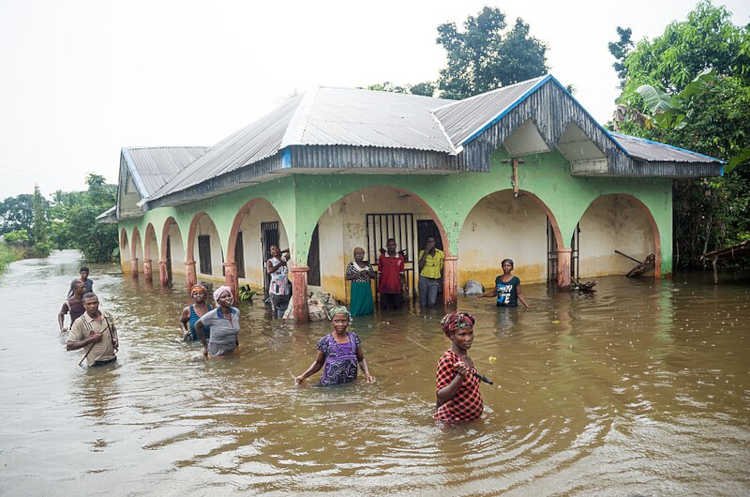
The problem is not that Nigeria lacks information but that it struggles to act on it, as urban centres continue to expand without the drainage infrastructure needed to manage heavy rainfall, leaving roads flooded, homes submerged, and daily life disrupted in ways that have become almost routine during the rainy season.
In riverine areas along the Niger and Benue basins, the situation is even more predictable, as communities repeatedly flagged as vulnerable remain in place without large-scale resettlement, embankment protection, or coordinated river basin management that could reduce their exposure year after year.
When flooding eventually happens, the burden shifts to the National Emergency Management Agency (NEMA), which is expected to respond to large-scale humanitarian crises with limited resources, often relying on emergency interventions and external support rather than a system that is fully prepared in advance.
For ordinary Nigerians, especially farmers in states like Benue, Kogi, and Anambra, flooding is not just about water but about livelihoods, as entire farming seasons can be lost overnight, pushing households into deeper economic uncertainty.
Women in affected communities often carry the heaviest load, managing food shortages, caring for displaced families, and navigating unsafe conditions in temporary shelters, while persons with disabilities face evacuation challenges that are rarely planned for in local emergency systems.
What this creates is a cycle where disasters are predicted, experienced, and then repeated, with each year bringing new reports and familiar outcomes, as if the country is watching the same film with better cameras but the same ending.
The Ministry of Water Resources needs to move beyond forecasts to clear, time-bound action on high-risk communities, state governments must treat flood preparedness as urgent infrastructure planning rather than seasonal reaction, and emergency agencies must be funded and equipped before the waters begin to rise.
Citizens also have a role in demanding more than warnings by asking what specific steps are being taken in their communities, what evacuation plans exist, and how quickly response teams can act when flooding begins.
Nigeria has shown that it can see the flood coming, but until planning, infrastructure, and response match that visibility, the country risks turning every new forecast into a familiar story where the warning is accurate and the outcome is unchanged.
Photo source: Hansel Ohioma