


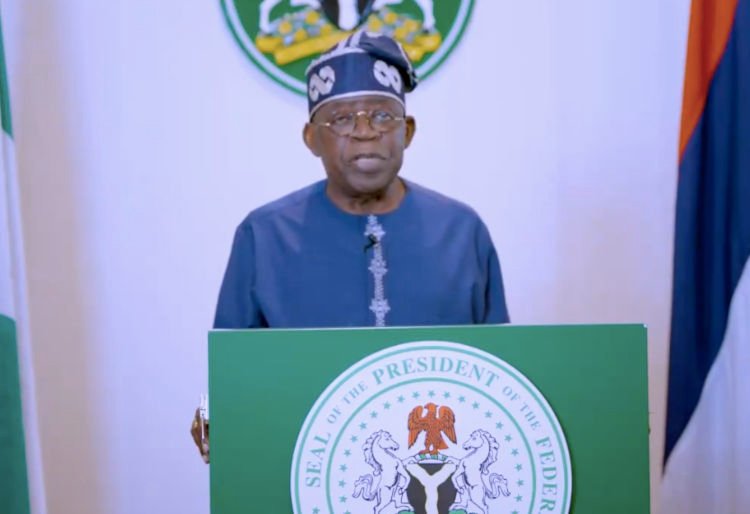
President Bola Tinubu’s insistence that his economic reforms are working, following the marking of his two-year anniversary, draws attention to how far the government has come in fulfilling its campaign promises.
Development Diaries reports that in a speech to highlight his second anniversary in office, President Tinubu listed the reforms carried out by his administration so far.
Two years ago, you entrusted me with the sacred responsibility to lead our nation at a time of historic challenges. Together, we faced those headwinds with courage and determination.
The economic and general situation I inherited required that we redirect the country’s affairs… pic.twitter.com/Mh2D8ur3k7
— Bola Ahmed Tinubu (@officialABAT) May 29, 2025
Recall that President Tinubu’s administration came into power with a bold 80-page policy document outlining an eight-point agenda and a set of ten campaign promises aimed at transforming Nigeria’s economy, security, and social infrastructure.
Two years into his tenure, the effectiveness of his administration can be gauged by examining his promises alongside the results he highlighted in his second-year anniversary speech.
With an 80-page campaign manifesto centred around job creation, economic revitalisation, national security, education, power, healthcare, and infrastructure development, the president’s eight-point agenda aimed to reposition Nigeria as a productive, secure, and prosperous nation.
However, two years in, the results are mixed, characterised by ambitious reforms, economic turbulence, and a widening gap between policy intent and lived reality.
Since his inauguration on 29 May 2023, Tinubu’s bold economic reforms have dominated public discourse.
The removal of the long-standing fuel subsidy and the unification of the foreign exchange rate were lauded by global financial institutions such as the World Bank and International Monetary Fund (IMF) for their potential to stabilise the economy and attract investment.
The federal government, for its part, is boasting of increased revenue, foreign direct investment inflows exceeding $500 million, and a rise in oil production to 1.61 million barrels per day as signs of progress.
It is also celebrating infrastructure efforts, including the Lagos-Calabar Coastal Highway and the Sokoto-Badagry Superhighway, as evidence of long-term planning.
However, for many Nigerians, these achievements remain abstract. Inflation remains painfully high, and the removal of subsidies has driven up the cost of living across the board.
Despite claims of easing inflation and stabilised revenues, millions have slid further into poverty, as confirmed by independent assessments and data from the National Bureau of Statistics (NBS).
Various social intervention programmes, such as the new Student Loan Scheme, a Consumer Credit Corporation, an increased NYSC allowance, and the recently announced N70,000 minimum wage, appear promising on paper, but the challenge remains in ensuring their effective and timely implementation.
Security is another area where the administration’s record is contested. Tinubu had promised to overhaul the country’s security architecture, end terrorism, and combat violent extremism.
His speech highlights the recruitment of forest guards and other operational gains, yet data and expert analysis suggest a deteriorating security landscape.
There has been a disturbing rise in abductions and violent attacks, and without meaningful progress on state policing and local government autonomy, federal efforts will continue to fall short.
While the government claims thousands of insurgents and criminals have been neutralised, a deeper transformation of Nigeria’s security architecture has yet to materialise at the community level.
In agriculture, President Tinubu pledged to enhance food production and support farmers.
But despite interventions, stakeholders say food insecurity has worsened, partly due to persistent insecurity in farming regions, climate challenges, and low levels of mechanisation.
Kabiru Ibrahim of the All Farmers Association of Nigeria (AFAN) in a media interview warned that without addressing these structural issues, agricultural support programmes will not yield significant results.
The temporary importation of food items between July and December 2024 underscores the ongoing failure to achieve food self-sufficiency.
Meanwhile, efforts in power generation and digital innovation, such as the CNG initiative and promotion of electric vehicles, signal long-term ambition.
Still, erratic electricity supply, collapse of the national grid and unreliable digital infrastructure continue to undermine both productivity and quality of life. The administration’s promise of affordable, sufficient electricity for all remains unfulfilled.
The president has also emphasised achievements in tax reforms, noting that Nigeria’s tax-to-GDP ratio rose from 10 percent to over 13.5 percent.
Education, food, and healthcare now attract 0 percent VAT, and several exemptions have been introduced to protect low-income households.
But again, the disconnect between macro-level policy and everyday affordability challenges has eroded public confidence.
Unless the government quickly scales up investments in social infrastructure and closes the delivery gap, these reforms risk being remembered more for their pain than their promise.
Politically, there are growing concerns that early 2027 campaign activities are diverting attention from governance. Stakeholders have urged the president to avoid distractions and focus squarely on delivering results.
They argue that improved livelihoods, rather than suppressing opposition or engineering political dominance, remain the most compelling case for a second term.
As Tinubu crosses the halfway mark of his presidency, this midpoint should serve not just as a milestone, but a moment of reckoning: to reflect, reassess, and redirect policies toward visible and measurable impacts.
As the administration steps into the second half of its tenure, Development Diaries calls on President Tinubu to bridge the gap between reform and reality.
Tinubu and his cabinet must focus less on lofty rhetoric and more on implementation, ensuring that economic growth translates into food on tables, security in communities, and jobs for young people.