



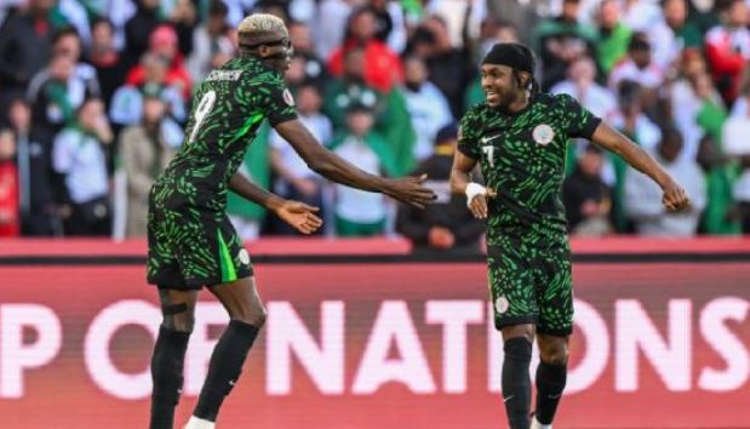
Nigeria booked their place in the semifinals of the 2025 Africa Cup of Nations in Morocco after a smashing win over Algeria on Saturday, but by Tuesday morning, many Nigerians had convened an emergency court session across social media platforms, with star player Victor Osimhen in the dock.
Development Diaries reports that clips of Osimhen’s heated exchange with teammates during the quarterfinal game against Mozambique went viral, and suddenly, the nation’s social media space had a verdict ready.
‘Who does he think he is’? ‘Bench him’! ‘He must respect the badge’!
For a few hours, it felt like Osimhen had committed a constitutional offence, with social media becoming a tribunal and every Nigerian a judge.
And by afternoon that Tuesday, memes had been minted, verdicts delivered, and Osimhen sentenced by the Supreme Court of Nigerian Vibes.
We thought that was the end of the drama. It was not, as another episode was already warming up on the touchline like a player eagerly waiting to come on.
By Wednesday, a fresh headline broke: Super Eagles refuse to train over unpaid bonuses. In seconds, the nation changed jerseys. ‘How can they treat our boys like this’? ‘Is this how you motivate champions’? ‘Government must intervene’!
The same timeline that benched Osimhen on Tuesday was now wrapping the entire team in patriotic hugs by Wednesday.
By Saturday night, after two goals, total dominance and Algeria dismantled like traffic cones at a driving school, the same country that had been furious all week was punching the air in joy.
This is the Nigerian cycle. We quarrel in the morning, forgive by evening, and forget completely once the goals start flowing. But this emotional amnesia is exactly why Nigerian football keeps repeating the same drama every tournament.
Nigeria’s 2–0 bulldozing of Algeria was more than a win; it was a loud reminder that talent and commitment have never been the core of the country’s problem. We need to give our football administration a bombastic side-eye.
The Super Eagles were faster, stronger, and sharper, as Algeria did not even register a single meaningful chance. The three-time African champions, who opened their account as AFCON winners at the expense of Algeria on home soil in 1980, looked like a team with a point to prove; and they did.
Yet days earlier, these same players were locked in a standoff with the Nigeria Football Federation (NFF) over unpaid entitlements, with captain Wilfred Ndidi stepping into the role of emergency accountant.
‘If they don’t pay, I will personally settle the bonuses’, he said. Pause and think about that.
In what other profession does a team leader promise to pay salaries because management might not? Imagine a hospital consultant telling nurses, ‘If the ministry fails, I will pay you myself’. Or a school principal assuring teachers, ‘If the government delays, I will cover it’.
Or should we accept that Nigerian football must run on vibes, patriotism, and personal sacrifice?
What makes this even more tragic is that this problem was supposedly solved years ago when the Super Eagles were preparing for the 2018 FIFA World Cup in Russia.
At the time, the Amaju Pinnick-led NFF proudly announced that they had concluded negotiations and agreed with the team with respect to bonuses, allowances, and share of income from FIFA.
Fast-forward to 2025, and Nigerian players are still chasing win bonuses like NYSC members waiting for allawee. So Nigerians, particularly football fans, must begin to ask questions that go beyond emotions.
If an agreement framework already exists, why are players still fighting for what was settled seven years ago? What exactly happened between Russia and now? Who dropped the ball?
Where are the documents that define these earnings? Why are they not public? If CAF and FIFA release funds ahead of tournaments, where do they go before reaching players? Who signs off on payments? Who tracks deadlines? What happens when those deadlines are missed?
Why does every major tournament begin with rumours of unrest? Why must players threaten a boycott before action happens? Why are last-minute government interventions now part of our football strategy? In which serious football nation is this normal?
As football fans, we argue about formations but ignore foundations. We debate substitutions but not systems.
We shout ‘play for the badge’ while refusing to ask whether those in charge are working for the badge, too.
The boys have done their job. They won all their group-stage matches and crushed both Mozambique and Algeria in the knockout phases while carrying stress they did not create.
Now it is the fans’ turn. Because if this win becomes another emotional high that wipes memory clean, the next tournament will deliver the same script of unpaid bonuses, training boycotts, emergency meetings, patriotic speeches, and last-minute payments.
As we enjoy this moment, let us demand a football system that works before kickoff, not one that wakes up only when embarrassment is near.
The Super Eagles have shown they can fly. Over to you, the NFF.
Photo source: Sebastien Bozon/AFP via Getty Images