



The comment by President Bola Tinubu urging editors to emphasise fairness and patriotism when reporting raises a legitimate question: how does his government really perceive criticism?
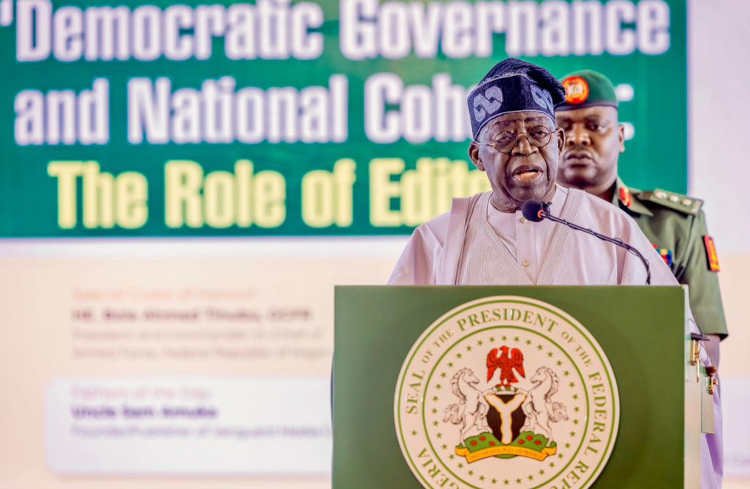
Development Diaries reports that President Tinubu, who spoke at the recent 21st All Nigerian Editors Conference, urged the media to ensure that their criticism of government policies and actions is informed, fair, and constructive, aimed at building a better Nigeria rather than undermining the nation.
‘Verification must be your anchor. Balance must be your principle’, he said. ‘Criticise government policy, but do so with knowledge and fairness. Let your aim be to help build, not destroy’.
If critique is only welcome when it doesn’t ‘undermine the country’s global image’, does this not risk turning democratic oversight into a conditional privilege rather than a fundamental right?
The state of press freedom in Nigeria shows the problem clearly.
According to Reporters Without Borders, Nigeria ranked 122nd out of 180 countries in the 2025 World Press Freedom Index, citing ‘significant governmental interference in the news media’, including pressure, harassment of journalists and media outlets, and even censorship.
CJID Press Attack Tracker recorded that from January to June 2024 alone, there were 37 verified press-freedom violations—including arrests, intimidation and unlawful detentions across the country.
Moreover, a 2024 report from the International Press Centre Safety and Protection of Journalists (SPJ) Hub (IPC-SPJ Hub) shows that attacks on journalists rose to 45 incidents, affecting at least 70 journalists and 3 media outlets, with security operatives implicated in 28 of the cases.
These statistics suggest a troubling disconnect. On the one hand, the President’s words promote a free press; on the other, the enforcement environment appears permissive of harassment and legal threats.
For example, journalist Daniel Ojukwu was detained for more than a week under the Cybercrime Act after publishing a corruption report, despite the law’s requirement for suspects to be charged or released within 48 hours.
When government rhetoric conditions reporting on patriotism and fairness, while statistics show a high incidence of repression, the outcome is predictable: self-censorship, weakened accountability and shrinking civic space.
The media should not be treated as an extension of national branding; it must remain a check on power.
President Tinubu should ensure his administration moves beyond symbolism and ensure that no journalist is threatened or detained for reporting facts.
Legal reforms, especially of laws like the Cybercrime Act that are frequently used to silence criticism must be enacted.
Security agencies must be directed to respect press freedom, and the government should publicly commit to transparency in its interactions with the media.
Photo source: Presidency NGR