




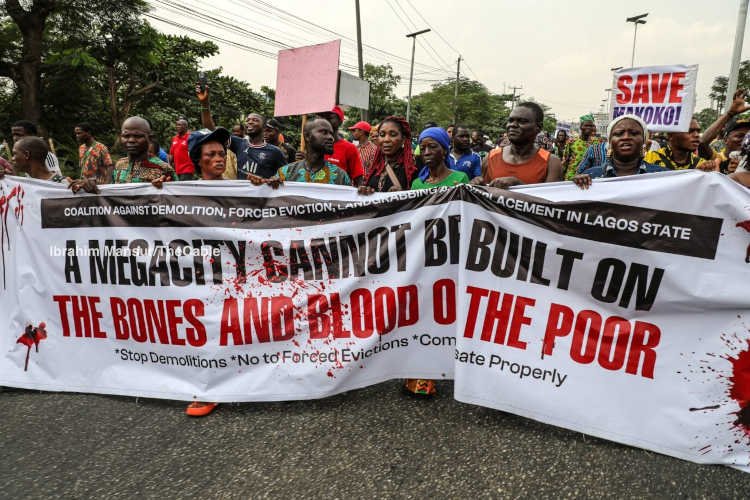
The protest by Lagos State residents against the demolition of their homes is another test Nigeria failed on policing, housing rights, and democratic accountability.
Development Diaries reports that the Nigerian police deployed tear gas to disperse hundreds of protesters who gathered in Ikeja to protest their displacement without adequate compensation or relocation.
It is understood that moments after the protest began, there was a standoff with the police, which degenerated into chaos as police officers fired tear gas canisters to disperse the crowd.
Protesters were forced to flee after smoke engulfed the area, triggering panic, with several protesters sustaining injuries.
Following the development, the Lagos State Police Command and the Lagos State Government have been criticised by human rights groups and activists over the arrest and the use of force on the protesters.
Here are the issues.
Forced evictions without due process violate the right to housing, recognised under international treaties Nigeria has ratified.
The UN Special Rapporteur on Housing has consistently warned that forced evictions deepen poverty, gender inequality, and urban insecurity.
Lagos demolitions disproportionately affect informal settlements, where residents already lack political power and legal representation.
People who lost their homes gathered to demand answers, compensation, and dignity, but instead of dialogue, the state responded with tear gas and arrests.
As a matter of fact, citizens protesting demolitions is evidence that governance has already broken down.
In this instance, the three governance systems which failed at the same time are urban governance, policing, and state accountability.
First, urban planning in Lagos State often moves fast without carrying people along, demolitions are carried out with weak notice, unclear compensation, and no trusted way to resolve complaints.
Second, policing treats protests as threats instead of constitutional rights, and third, the state shields itself from accountability by using force rather than explanation.
Together, these failures turn citizens into enemies and public policy into conflict.
The root of the problem is not one police officer or one protest. Demolitions without a rights-based process push people into the streets because there is no other voice left.
At the same time, police training and command culture still see crowds as danger, not citizens exercising Section 40 of the 1999 Constitution (as amended), which guarantees freedom of assembly.
The Police Act 2020 and human rights standards require dialogue, proportional force, and de-escalation, but those rules are rarely followed, which reflects a failure of training, orders, and political direction.
The state government failed in its responsibility as it designed urban renewal policies that prioritise speed and image over consultation and resettlement, while relevant ministries and agencies failed to provide clear notice, compensation, and dispute resolution.
Police leadership authorised force instead of mediation and must answer for command responsibility. Lawmakers at both state and national levels also failed in oversight, allowing forced evictions and protest crackdowns to continue unchecked.
From a gender and equity perspective, women, children, persons with disabilities, and the urban poor lose homes, livelihoods, safety, and stability all at once.
When protests are suppressed, the state sends a message that policy disputes will be settled by force, not dialogue.
Nigerians must now demand answers, ask if notices were issued, if resettlement was funded, and who approved the police action?
As citizens, we should document and report, collect videos, testimonies, medical reports, submit petitions to the Police Service Commission and National Human Rights Commission, demand legislative oversight, and contact your state assembly member to ask for a public hearing on the demolition and police conduct.
The Lagos State Government and the Lagos State House of Assembly should suspend disputed demolitions, publish clear compensation plans, investigate police conduct, and strengthen laws against forced evictions.
The Nigerian police should release an account of the rules of engagement used, sanction officers involved in excessive force and retrain units on protest policing and human rights.
Democracy cannot survive where protest is criminalised and eviction is called development.
Photo source: The Cable