




By Femi Aderibigbe and Jamila Haruna
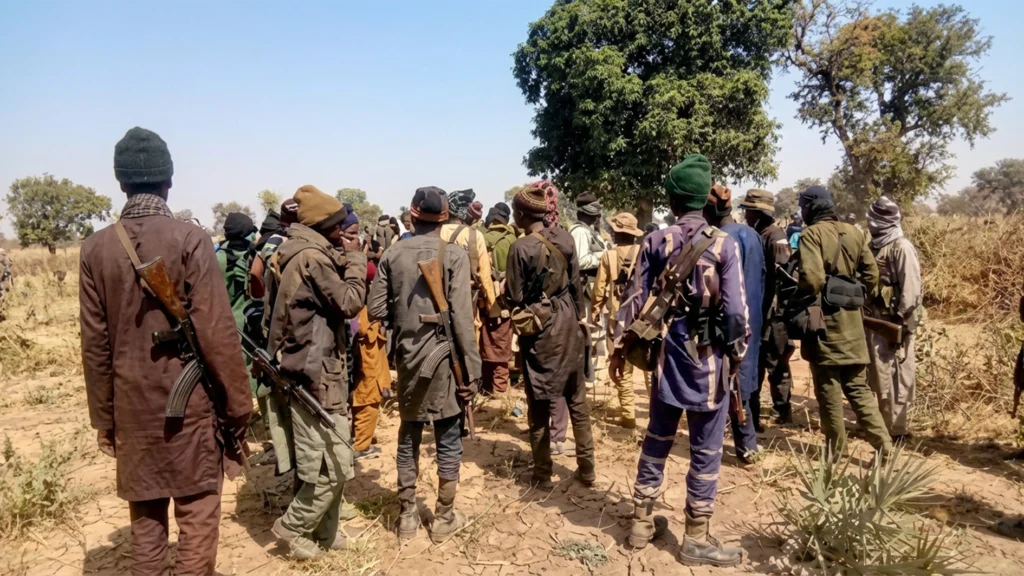
A man walking away from his home in Unguwar Lalle, with the road ahead of him and armed men behind him, spoke into a phone camera and said what no official communiqué will ever admit.
‘If we are being protected, and left with hunger, we will rely on what God makes available for us to eat, even if it is mere corn, but we are burdened by insecurity’, he said in Hausa. ‘The government has betrayed us, and we will never forgive them. The residents of Lalle community have completely evacuated their homes. We are hungry and unsafe, it is too much of a burden on us, and we hope that God Almighty punishes the government on our behalf’.
He continued, ‘The government officials are there in their safe abodes with their children while we are left out here running for our lives. The government of Sokoto has truly betrayed our trust. Imagine how humans are embarking on an endless journey on foot, with no destination in sight’.
The last part deserves the attention of anyone holding public office in Nigeria because the man was no longer asking his government for protection or accountability; he was asking God to punish it on his behalf. A citizen who has stopped expecting the state to answer him is describing a relationship with government that has broken down, and that loss of trust carries consequences far beyond one angry video.
The evidence
Unguwar Lalle, in Sabon Birni area of Sokoto State, had until recently served as a refuge for people escaping smaller communities because it had security personnel and vigilante groups. In early August 2026, that refuge emptied too, after at least nine communities, including Tsamaye, Lajinge, Alkalawa and Lalle, were deserted following renewed threats from armed groups.
Men, women and children trekked through the night towards the local government headquarters, with many walking between 30 and 50 kilometres because vehicles were unavailable while flooding had cut the main road to Sokoto. More than 77 people were reportedly killed across the state between late June and early August, while a boat carrying fleeing residents capsized during an attack on Tsamaye, sweeping away roughly two dozen people, most of them women and children.
So when the man spoke of an endless journey on foot with no destination in sight, he was describing what families around him had actually experienced.
What awaits many of these people at the end of that journey is another registration exercise. Displaced families give their names when they arrive from a village emptied by violence, give them again when another distribution list is compiled and give them again when emergency officials conduct a fresh enumeration.
The count is supposed to determine what assistance reaches them, but Sokoto State has yet to publish a resettlement plan that shows what happens after the names have been recorded.
This is part of a wider displacement crisis across the northwest, where banditry, mass abductions and village raids have uprooted communities across Sokoto, Zamfara, Katsina and Kebbi. The subregion does not have the same humanitarian infrastructure that has developed around the insurgency in the northeast, while shrinking humanitarian funding is forcing agencies to serve fewer people even as assessed needs rise.
That makes registration more than an administrative exercise.
What is failing
The first failure is civilian protection. Section 14(2)(b) of the constitution states that the security and welfare of the people shall be the primary purpose of government, but communities on the periphery of Sokoto continue to experience the same cycle of attack, deployment announcement and renewed attack.
Rural, low-income farming communities on the state’s eastern frontier have no protective force sufficient to hold ground, and their safety appears to receive less sustained attention than communities closer to the seat of government. When armed men struck Garin Idi in July, they struck the home community of Sokoto State’s deputy governor, leaving ordinary villagers with even less reason to believe that distance from political power will protect them.
The second failure is what happens after people are forced from their homes. Registration without reliable data, continuity and a plan for return, local integration or resettlement leaves displaced families moving from one temporary arrangement to another without knowing what government intends to do with them.
The problem begins with the data itself. Registers that do not identify people by sex, age and disability cannot properly guide protection or assistance, while repeated registration without a published plan can make displaced people question whether providing their information changes anything.
Nigeria’s own framework recognises return, local integration and resettlement as possible durable solutions for internally displaced people. What is missing in Sabon Birni is a public plan that identifies which option is being pursued, when it should happen and what security conditions must first be met.
Then there is the communication failure. Citizens need a channel through which their concerns reach government and credible responses that tell them what is being done, when it will happen and who is responsible.
In Sabon Birni, a phone recording has become one of the clearest ways for an abandoned community to make itself heard because formal channels have failed to produce sufficient action or reassurance. The state announces deployments, while residents continue walking away from their homes.
The economist Albert Hirschman described the citizen’s options as loyalty, voice and exit. The man in the video appears to have exhausted loyalty, found that his voice produced no response and taken the only exit available to him, fleeing on foot. His appeal to God is a voice in its most powerless form.
Who is responsible?
Protection against armed groups is principally a federal responsibility involving the Office of the National Security Advisor (NSA), the Defence Headquarters and the Nigerian Army. The Sokoto State Emergency Management Agency (SSEMA is responsible for registration and holds the displacement data, while the National Emergency Management Agency (NEMA) coordinates the federal emergency response.
The Federal Ministry of Humanitarian Affairs and Poverty Reduction has responsibility for humanitarian policy and financing, while the Sokoto State Government, under Governor Ahmed Aliyu, owes displaced citizens assistance once they are uprooted. The Sabon Birni local authority and National Assembly members representing the affected communities also have responsibilities for local response, advocacy and oversight.
The displaced residents themselves have praised the courage of soldiers on the ground and asked for more personnel, equipment and logistics. Their complaint is directed at a system that has failed to provide sustained protection, leaving soldiers to confront a crisis without sufficient resources.
The rights at stake
Sections 33 and 34 of the constitution protect the right to life and the dignity of the human person. Families forced from their homes, made to walk tens of kilometres and left without adequate shelter are living with the consequences when those rights are not effectively protected.
Nigeria is also a party to the African Union Convention for the Protection and Assistance of Internally Displaced Persons in Africa, known as the Kampala Convention, which requires states to protect and assist people displaced within their territory and work towards durable solutions.
The Universal Basic Education Act also matters here because displacement does not suspend a child’s right to basic education. A child forced out of school by violence remains a child entitled to education wherever that child is eventually registered.
The same principle applies to the data collected from displaced families, as public institutions handling their registration are required to protect personal information under Nigeria’s data-protection law, making accurate and responsible registration part of the response rather than a bureaucratic afterthought.
Who is left behind
The people swept away in the capsized boat were mostly women and children. Those walking through the night included the rural poor, elderly people and persons with disabilities for whom a 30- or 50-kilometre journey is hardly an escape route.
Displaced women and girls also face increased risks of gender-based violence where shelters are overcrowded, lighting is poor and sanitation facilities are shared or far away. Female-headed households can become particularly vulnerable when men are killed or separated from their families.
Persons with disabilities can disappear from official planning altogether when registration systems fail to capture functional difficulties, while children who remain out of school for years lose educational opportunities that cannot simply be restored when the violence ends.
The register should tell government who needs help and what kind of help they need. When it does not, the people who already have the least capacity to survive displacement become the easiest to leave out.
Turning the lament into demands
ImpactHouse Centre for Development Communication has taken the complaint into the formal accountability space through an open letter to Governor Aliyu and President Bola Tinubu, demanding sustained protection for Sabon Birni, registration and humanitarian assistance for displaced residents as internally displaced persons, the reopening of the flooded road and direct engagement with affected communities.
The demands give the two governments specific issues to answer publicly and create a record against which their response can be measured.
Citizens and civil society organisations should continue to document the experiences of displaced families and press for their immediate registration and humanitarian assistance. Communities should also demand that their state assembly representatives publicly account for the protection requested for their constituencies and what government eventually delivered.
Sustained protection requires the Office of the NSA and the Nigerian army to provide the personnel, equipment and logistics residents have requested, while SSEMA and NEMA should publish reliable displacement data and a clear plan for assistance and durable solutions.
For displaced children, the Sokoto State Universal Basic Education Board should publish an enrolment plan, while the Federal Ministry of Humanitarian Affairs and Poverty Reduction should publish current funding allocations for north-western displacement and explain how the region’s needs are being addressed.
On access, the government of Sokoto State should reopen the flooded road so families fleeing armed groups are not trapped between the threat behind them and floodwater ahead.
A citizen of this country has asked God to punish his government because he no longer believes his government will answer him. That is a dangerous signal in a country where millions of citizens already feel unheard, unseen and abandoned by the institutions meant to protect them.
If that loss of faith continues unchecked, the question will eventually be how much alienation a country can absorb before it turns into open defiance. The most consequential response available to the government is therefore protection, assistance and the honest communication that public office demands.
Jamila Haruna is a management consultant with G-Klan & Springs Consult Ltd. She translated the Lalle testimony from Hausa.
Disclosure: ImpactHouse Centre for Development Communication, referenced in this article, shares a founder with Development Diaries.