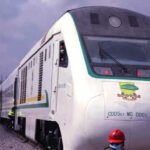



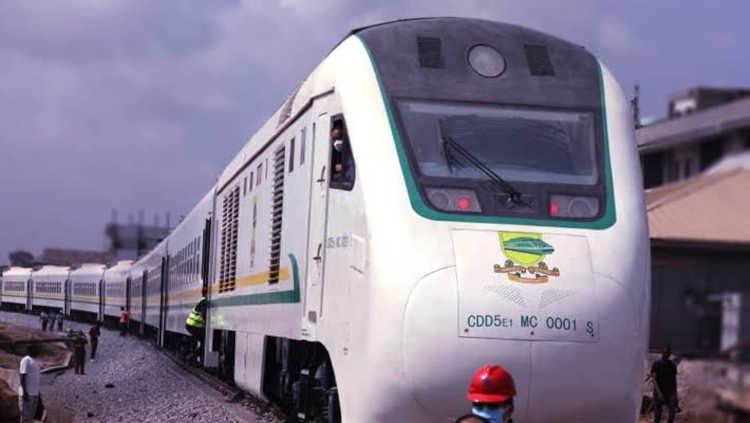
At 6:30 a.m., commuters have gathered at the Idu train station like people who have already made peace with disappointment, with phones fully charged and snacks carefully packed.
A few minutes later, some parents were already practising the apology they would offer their bosses if the train did its famous ‘unavailable’ routine.
And somewhere in the line, a man cracks the joke that maybe the smartest thing is to start trekking to Kaduna now. ‘No worry, you go still reach before the train’, he said.
Yes, it is funny until the joke walks into the Senate chamber and sits down.
After several complaints from commuters, the Nigerian Senate has finally admitted that the rail system in the country is collapsing, with the Senate President, Godswill Akpabio, lamenting that the Abuja–Kaduna trip has decayed so badly that a bicycle or keke could now outrun a multi-billion-naira train.
Also speaking was Bauchi Central’s Senator Abdul Ningi, who alleged that the Abuja–Kaduna–Kano rail contract was poorly executed, and despite generating over N1.8 billion, the service continues to deteriorate.
Once upon a time, the journey took one and a half hours. Now, it sometimes takes over three hours.
This is why citizens must resist the temptation to treat the rail crisis as normal dysfunction or political theatre. It is a collapse of public value in plain sight, and the Senate has merely arrived late to a disaster that commuters have been living inside.
The first system breaking down is basic service delivery. Trains slow down because maintenance schedules are ignored, tracks deteriorate, rolling stock is unavailable, or operational planning has collapsed.
When a journey doubles in duration and trip frequency shrinks to one lonely service a day, the message is that the system cannot sustain itself.
Then comes the deeper problem of Nigeria’s contract governance. A senator does not casually accuse a project of poor execution without triggering serious questions.
What were the standards? Who supervised? Who signed off on completion? What defects were recorded? What penalties exist for non-performance?
If those answers cannot be spoken in public, then the country did not build infrastructure but merely commissioned a ceremony.
Security is the third layer of failure. Yes, the corridor has faced serious security threats, and those concerns are valid. But insecurity cannot become the catch-all excuse that shields mismanagement, waste, or incompetence.
At the heart of everything is Nigeria’s biggest governance flaw, which is the absence of consequences. This is a country where commissioning matters more than performance, just as revenue numbers can climb while service collapses.
If the corridor truly generates over N1.8 billion, Nigerians deserve to know what that money is doing.
This is also a gender and equity issue, because when transport becomes unpredictable, women often pay the highest price of unsafe travel hours, higher vulnerability along the route, and increased caregiving stress when daily routines are disrupted.
Persons with disabilities are hit even harder because accessibility is already weak, while traders lose income, students lose time, and families lose dignity.
So the real question is, will this Senate probe produce consequences or just content?
If the committee submits a vague summary, hides critical findings, avoids naming offenders, or buries recommendations in bureaucratic fog, then nothing has changed.
But if Nigerians push for a full public report, for service metrics published monthly, for contract documents openly scrutinised, and for sanctions that actually sting, then this moment can become a turning point.
If the Senate wants to show Nigerians that this is more than noise, the first proof is to publish everything, fix something, and punish someone.
Until then, commuters will keep arriving at 6:30 a.m., snacks in hand, apologies rehearsed, ready to race a train that sometimes behaves like it is allergic to movement.
Photo source: Nigeria Railway Corporation