




President Donald Trump’s Davos appearances are never about just speeches. This year’s message, a mix of protectionist bargaining, the launch of a unilateral ‘Board of Peace’, and the completion of the United States’ withdrawal from the World Health Organisation (WHO), raises urgent questions for Africa’s health security and global standing.
His message accelerates a rupture in the institutions that many African states have relied on as buffers against shocks. And if Africa reads this moment correctly, it can turn disruption into agency. But if it misreads it, it will inherit vulnerability.
Below, I describe what was announced in Davos, why the WHO exit matters now, what this new posture actually portends for African development and security, and the pan-Africanist agenda the continent must adopt, beginning immediately.
What happened in Davos, the Board of Peace and a new posture
President Trump launched what he called a Board of Peace, a politically backed, fast-action body he pitched as more agile than UN mechanisms and able to ‘do pretty much whatever we want to do’ to stabilise conflict zones, beginning with Gaza.
The announcement was accompanied by a charter and a signing ceremony, with critics warning that the board risks rivaling the UN and undermining established peace architecture. Several Western partners expressed caution about its design and optics.
Alongside that, the formal U.S. withdrawal from the WHO takes effect today, 23 January, 2026. The U.S. earlier gave notice under domestic law; this time, the Biden interregnum did not reverse the exit, and the administration left unpaid dues for 2024–2025 (amounting in reporting to roughly $260–$280 million), reducing Washington’s financial role. The WHO has responded to lost income with a strict austerity programme, staff reductions, and budget cuts that will materially weaken its global capacities.
Together, these moves show a clear pattern of the U.S. recasting global governance from rules, funding, and shared responsibilities towards selective, bilateral, and ad-hoc mechanisms under its influence.
Why the WHO exit matters for Africa now
The WHO was never perfect. But as the single global coordinator for disease surveillance, emergency response, and technical guidance, it played a non-substitutable role in pandemic response, vaccination campaigns, and health system support.
The U.S. was the organisation’s largest single contributor for decades; its funded share paid for programmes that disproportionately supported low- and middle-income countries. The practical effect of Washington’s exit and unpaid dues is immediate in the areas of fewer staff, reduced programme budgets, lower surge capacity for outbreaks, and strained supply chains for essential medicines and vaccines.
For Africa, that means weaker early warning and response to outbreaks; reduced technical support for national immunisation and disease control programmes; and a fiscal squeeze on global health partnerships that previously filled gaps at scale. In short, health security, a bedrock of human and economic resilience, has been degraded at precisely the moment when climate shocks and insecurity make outbreaks likelier.
Trump’s Davos initiatives are part of a broader strategic logic of multilateralism constraining unilateral advantage; global public goods are treated as discretionary costs; and development and peace are reframed as transactional, short-term deals. That logic produces three effects for Africa.
First is the erosion of shock absorbers. Concessional finance, coordinated humanitarian response, peacekeeping and pandemic coordination become brittle or conditional. That leaves weaker states more exposed to floods, pandemics and conflict spillovers.
A harsher bargaining environment is the second effect, as bilateral deals replace rules. Fragmented African states negotiating one-by-one face steep power asymmetries.
The third effect is the end of easy excuses. With less international buffering, domestic governance, fiscal choices and institutional capacity are placed in sharper relief, and rightly so.
The fracture exposes how dependent many African strategies became on external buffers that were never fully under African control.
A Pan-Africanist agenda; strategic, urgent, practical
If this is a stress test, Africa must treat it as a mandate for action. The continent needs a five-part agenda, immediate and structural, that pivots from dependency to collective agency.
1. Emergency health sovereignty (immediate, 0–90 days)
AU health ministers must convene an emergency session this week to agree on a binding Continental Health Continuity Plan. This plan could cover pooled procurement, emergency staffing rosters (deployable across borders), and rapid financing mechanisms to fill WHO shortfalls while ensuring programme continuity.
National governments should immediately increase predictable domestic allocations to primary health and surge financing for vaccine procurement, and publish budgets and spending plans within 30 days.
2. Scale African multilateral funding (3–12 months)
Capitalise an African Emergency Health Fund (seeded by AfDB, regional banks, and voluntary AU member contributions) to underwrite outbreak response and supply chain gaps. Fast-track a buffer financing window in AfDB for health, food, and displacement emergencies.
3. Translate AfCFTA into strategic leverage (6–24 months)
Use AfCFTA for industrial policy to harmonise standards for pharmaceuticals, vaccines, and diagnostics; design regional manufacturing corridors for inputs and finished products; and deploy tariff-free zones for vaccine manufacturing.
4. Rebuild regional public goods: food, energy, logistics (1–3 years)
Treat food systems, energy grids, and regional transport as security infrastructure. Invest in storage, agro-processing, and cross-border corridors that reduce import dependence and the macro-vulnerability that Trump’s rhetoric exploits.
5. Institutionalise accountability and peer enforcement (ongoing)
AU and RECs must back peer-review enforcement, not platitudes, linking reform compliance to access to pooled resources. Strengthen AU technical capacity to negotiate complex global deals from a position of prepared unity.
What citizens and civic actors should demand now
Demand transparency by asking ministers for a public contingency plan showing how health and emergency services will be maintained after the WHO exit. Pressure parliaments to ring-fence emergency health and food budgets this quarter.
Support community health and civil society coalitions to monitor vaccine supply chains, outbreak reporting, and humanitarian access.
Final Provocation: turn rupture into discipline
President Trump’s Davos showmanship and the practical blow of the WHO withdrawal are structural accelerants. They should be read as a clarifying test, not a calamity to be passively mourned. Africa must accept the world as a field of transactional bargains and remain reactive, or build internal, regional, and continental architectures that make those bargains less consequential.
Multilateralism is relocating, and Africa must decide where it will sit at the new table. Will the continent be 54 reactive units negotiating from weakness or a single strategic civilisation negotiating from pooled strength?
If Africans do not move now, the fractures laid bare in Davos will become the permanent terrain of our vulnerability. If we do, those same fractures can become the scaffolding for African sovereignty.
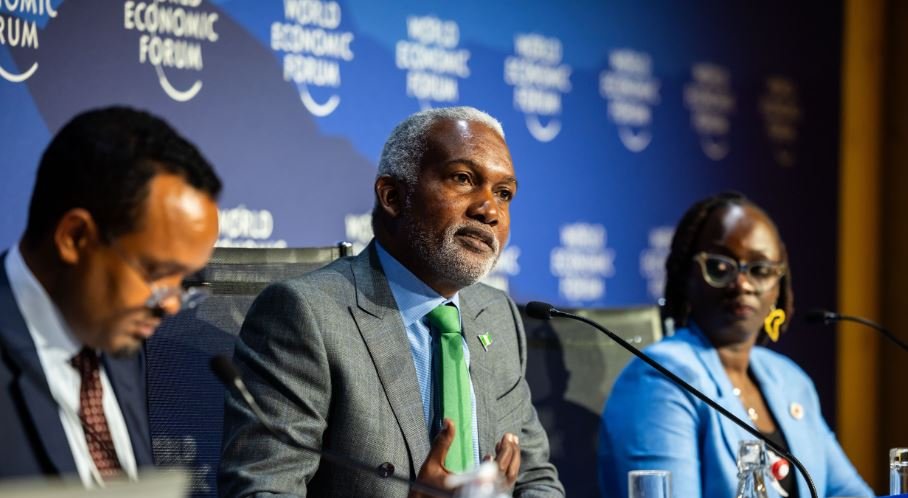
Photo source: Ciaran McCrickard/World Economic Forum