






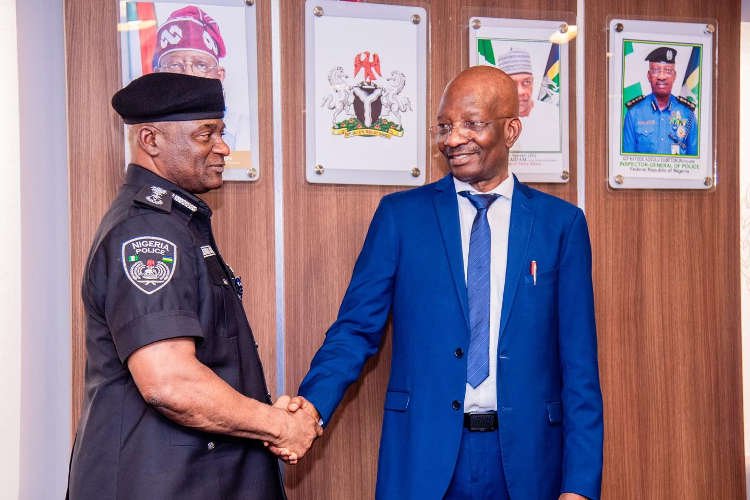
If Nigerians ever needed proof that big talk is a national policing culture, they only have to remember the day former police boss Kayode Egbetokun told the country he felt like a tiger ready to chase criminals, and now hear his successor, Tunji Disu, declare total war on corruption and impunity.
Development Diaries reports that President Bola Tinubu has decorated the recently appointed acting Inspector General of Police (IGP), Disu, whom he charged to restore discipline, rebuild trust, and strengthen the Nigeria Police Force ahead of the 2027 elections.
And as always, citizens are expected to clap first and ask questions later, even though history has taught us to hold the applause until the performance begins.
In fairness, Disu spoke well, as he promised zero tolerance for corruption, pledged to end impunity, and even reminded police officers that citizens are their real bosses.
While those lines are wonderful, Nigerians have heard similar promises from every incoming police chief for the past two decades, and the reality has been a system where corruption is a problem and part of the operating manual.
The key issue is that policing in Nigeria continues to fail because reforms are announced but rarely implemented, discipline is preached but selectively enforced, and public trust is treated as something citizens must donate rather than something the institution must earn.
If Disu declares war on corruption, the question is whether the police system will finally fight back, or simply raise a white flag the moment the cameras are turned off.
At its core, the failure is structural, as oversight mechanisms are weak, with internal disciplinary systems moving at the speed of palm oil in harmattan.
Funding for training, welfare, and modern policing tools is inconsistent, and the culture of impunity, from illegal arrests to extortion at checkpoints, remains deeply entrenched.
When the system itself rewards bad behaviour and punishes integrity, declarations of war sound like motivational speeches delivered at send-forth ceremonies.
In this matter, the duty-bearers sit in every corridor of the policing and governance chain, and this includes the Ministry of Police Affairs, the Police Service Commission, the leadership of the Nigeria Police Force, the National Assembly committees on police affairs, state commissioners of police, and every supervisory structure that is supposed to enforce standards but too often acts like a spectator.
They all share blame for a system that allows officers to brutalise citizens, extort road users, sexually harass women and girls during ‘stop and search’, and respond to protests with violence rather than protection.
This is also a rights issue, as Nigeria is obligated under its constitution and under international law, including the African Charter on Human and Peoples’ Rights, to ensure policing that respects dignity, protects citizens, and guarantees access to justice.
Corruption and impunity in policing violate the rights to life, freedom of movement, fair treatment, and safety. The Nigerian state is therefore not doing the public a favour by promising reform; it is merely attempting to meet its legal obligation.
With respect to equity, the stakes are even higher, as women and girls face heightened risks of sexual exploitation from security officers who misuse power, while young people encounter profiling, harassment, and brutality disproportionately.
For their part, persons living with disabilities face communication barriers, inaccessible police stations, and discriminatory treatment.
Citizens must therefore move beyond watching new IGP speeches like Nollywood premieres. We should demand transparency on disciplinary cases, report abuses through documented channels, insist on the publication of audit records, and support civil society monitoring of police conduct.
Government institutions must step up as well. The Ministry of Police Affairs must develop a measurable timeline for reforms. The Police Service Commission must enforce discipline without political pressure, while the National Assembly must conduct oversight hearings that produce results.
What citizens want is not another tiger speech, another war on corruption, or another round of promises delivered at decoration ceremonies.
Nigerians want a police system where discipline is routine, accountability is non-negotiable, and professionalism is not an inspirational quote but a daily practice.
Photo source: Nigerian Police
