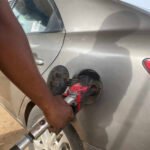
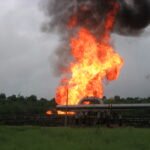
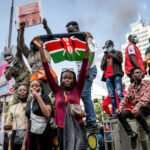

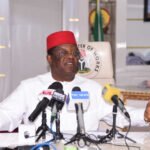


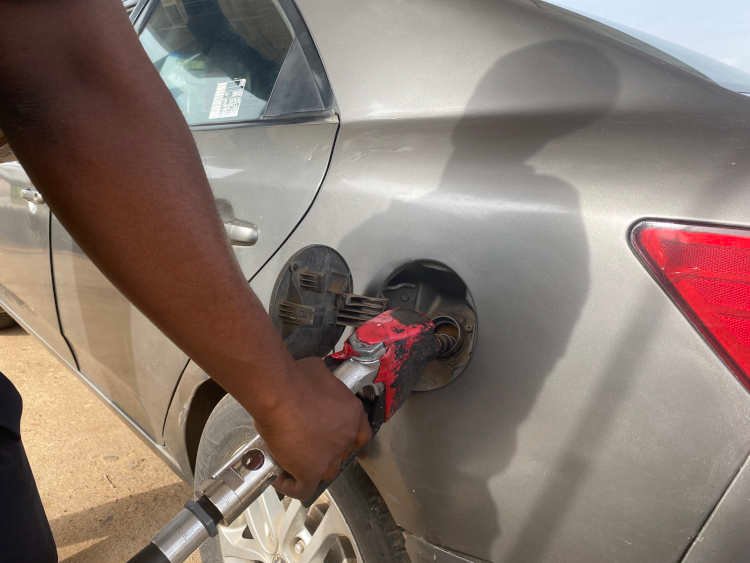
Petrol has hit N950, and once again, Nigerians are paying for a US–Israel–Iran war they did not start, did not vote for, and cannot pronounce in any fuel queue without sighing.
Development Diaries reports that the war has officially reached streets, wallets, and already traumatised transportation budgets in Nigeria and the continent.
Thanks to the global tension ignited by coordinated strikes from the governments of United States and Israel on Iran, and Iran’s dramatic response at the critical Strait of Hormuz, crude prices have shot up like they are competing in an Olympic high jump.
And because global oil economics does not believe in neighbourly love, Nigeria and several African countries get slapped immediately.
Dangote Refinery has raised its gantry price to N874 per litre, petroleum marketers have adjusted their calculators, and Nigerians have adjusted their walking shoes.
We understand that some petrol stations in Lagos and Abuja are already flirting with N950 per litre, and from the look of things, N1,000 is waiting behind the curtain, slightly powdered, ready for its stage entrance.
So ‘with subsidy gone’, government cushioning mechanisms have all the elasticity of a concrete floor.
But this development is actually about whether the government of Nigeria can protect citizens from global volatility, manage energy markets, and provide relief without sinking back into opaque, trillion-naira subsidy chaos.
It is about whether institutions tasked with oversight, such as the Ministry of Petroleum Resources, the Nigerian Midstream and Downstream Petroleum Regulatory Authority (NMDPRA), and the state-owned NNPC, can act with urgency, transparency, and fairness.
And let’s not forget the Dangote Refinery, whose pricing decisions ripple across the nation long before most Nigerians have brushed their teeth.
Citizens are already feeling the consequences sharply, as transport fares are rising by the hour, just as food prices are preparing for another upward journey.
Meanwhile, small businesses that depend on petrol generators, such as hair salons, barbers, frozen-food sellers, and artisans, are bracing for an economic migraine that cannot be treated with paracetamol.
And of course, women who already pay more for transport and household care burdens, young people struggling with unemployment, and persons with disabilities who face amplified mobility and cost barriers, will carry the heaviest load.
Access to energy is a rights issue, and Nigeria is obligated to protect citizens’ right to economic survival, health, mobility, and dignity. A country cannot allow petroleum pricing to swing like a wrecking ball across people’s lives every time a foreign conflict breaks out.
The duty-bearers cannot hide behind international headlines. Nigeria did not block the Strait of Hormuz, but Nigeria can block the suffering if it chooses to.
Government must act immediately by deploying temporary price-stabilisation mechanisms, transport support for low-income groups, transparency on the pricing formula, and a clear roadmap for protecting households from global oil shocks. What Nigeria cannot do is shrug and pretend it is a helpless bystander.
And to citizens, please, save the energy you want to use to organise pro-Iran or anti-US protests. None of those governments will notice you. Use that energy instead to demand accountability right here at home, where your suffering is directly shaped.
Demand that the NMDPRA publish the pricing structure guiding PMS in the country. Demand that the Ministry of Petroleum Resources engage publicly with citizens about stabilisation plans. Demand that NNPC Ltd explain its national supply strategy in times of global energy disruptions.
Nigerians can also act locally. Transport unions and community associations should document fare increases and pressure their state governments for emergency mobility support. Civil society groups must insist that any relief package prioritises women-headed households, young commuters, and persons with disabilities who depend on public or para-transit systems.
And to the institutions, they need to step up. The NMDPRA must regulate firmly and transparently. NNPC Ltd must communicate openly. The Ministry of Petroleum Resources must stop issuing vague assurances and instead present clear, data-backed plans.
A government that cannot shield its citizens from predictable global price shocks has chosen governance by autopilot, and Nigeria cannot continue to outsource the economic safety of its people to geopolitical roulette.