





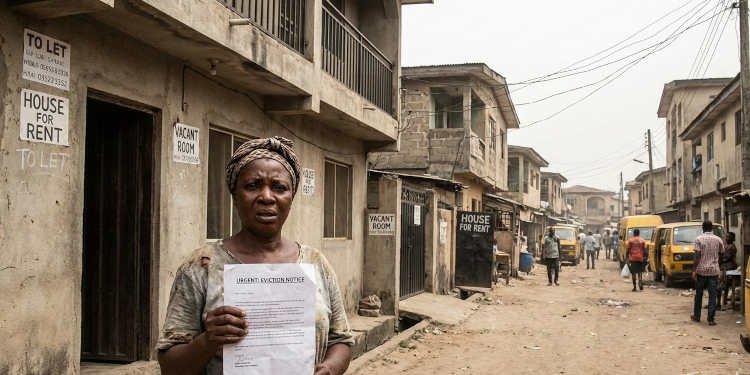
When rent is higher than people’s yearly income in Nigeria, it is a national failure that should worry our leaders.
Development Diaries reports that rents in most parts of southern Nigeria have reached a new high, as they have doubled in many places, making housing too expensive for most residents to afford.
According to a report by The Guardian, the housing crisis is hitting cities in Lagos, Ogun, Oyo, Ekiti, Osun, Ondo, Akwa Ibom, Delta, and Bayelsa the hardest.
Also, rising rent is making homes scarce and putting more financial pressure on many households.
Who can live decently in cities? Only the rich. Who gets displaced? The poor and middle class. Who absorbs economic shocks alone? Ordinary families, without any state support.
Development Diaries treats housing as a public duty, not a private misfortune, and right now, the state has walked away from that duty.
The system failing here is Nigeria’s housing and urban development system, as housing policy is weak, rent regulation is weak or not enforced, and urban planning is poor, with consumer protection in rental markets almost dead.
Social welfare does not match rising costs because housing is being treated like a luxury good, not a basic service. In simple words, the government has left shelter to profit-driven markets.
Why is this happening?
First, policy failure. There is no serious national affordable housing plan, and rent control laws are either absent or ignored, and housing policy favours rich buyers, not renters.
Second, regulatory failure. Estate agents are mostly unlicensed, rent hikes are unchecked, and there are no working rent tribunals.
Third, state capacity failure, with Lagos State delivering about 11,000 homes in six years against a deficit of over 3.4 million. That is like pouring a cup of water into a dry river.
Fourth, economic failure. Wages are flat, but rents are flying. A N70,000 minimum wage cannot pay one to three million naira in rent.
This is also a rights issue. As of January 2026, the Nigerian government had updated the housing deficit to approximately 14.9 million to 15 million units.
Rents have jumped 50–350 percent in two years, with two-bedroom flats now costing one to three million naira in cities where the minimum wage is N70,000.
When children are withdrawn from school because rent eats school fees, when families crowd into unsafe rooms, when civil servants surrender their whole salaries to landlords, the state has failed its duty of care.
Women face higher housing insecurity because they earn less and carry care burdens. As for children, they suffer from unstable schooling. Also, persons with disabilities are priced out of accessible homes, while informal workers and civil servants survive on loans after paying rent.
Rural migrants are pushed into slums or forced back to villages. Nigeria now runs a ‘pay-rent-or-disappear’ housing policy. If you cannot pay, relocate, squat, or vanish quietly.
Cement is expensive, yes. Agents are greedy, yes. But the real problem is a development model where cities grow without housing plans, and citizens absorb shocks alone.
Nigerians must now demand that state governments publish housing supply targets and affordable rental housing plans.
We should petition state assemblies to pass and enforce rent control and tenant protection laws, organise tenants’ associations in estates, communities, and local government areas.
The state governments, state houses of assembly, ministries of housing and urban development, land registries, urban planning authorities, and regulatory agencies must pass and enforce tenant protection laws, set up rent tribunals in every local government, license and regulate estate agents and invest in state-led affordable rental housing.
Photo source: AI/Google Gemini