



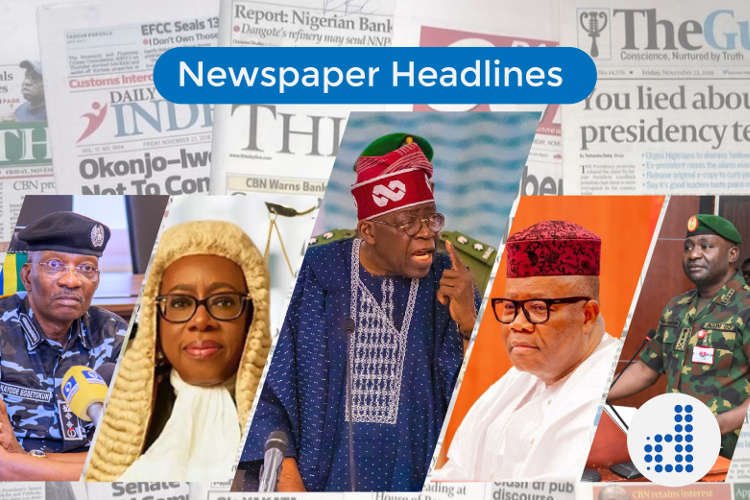
As we often say, ‘thank God it’s Friday’, and welcome to today’s roundup of Nigerian newspaper headlines paired with our advocacy-driven demands for government action on issues affecting citizens.
1. The Guardian: Nigeria@65: Two Days after Independence, Bitter Divisions Persist over Nation’s Future
We begin with The Guardian, which reports that two days after Nigeria marked 65 years of independence, sharp divisions have persisted over the country’s direction, with the ruling All Progressives Congress (APC) celebrating President Bola Tinubu’s reforms as signs of renewal while opposition parties, activists and rights groups denounced deepening poverty, corruption, insecurity and the betrayal of democratic hopes.
Our Take: Fellow Nigerians, 65 years after independence, it is clear that speeches alone cannot put food on the table or end the endless queues at fuel stations. You need to hold your leaders to their promises, demanding real action beyond recycled rhetoric. And Mr President, Nigerians are not asking for poetry but for policies that actually work, because if this is ‘renewal’, then perhaps citizens’ suffering has already gotten its own pension plan.
2. Daily Trust: Erratic power hinders businesses in Kaduna, Kano, Katsina
Daily Trust reports that despite the increase in power generation, customers in Kaduna, Katsina, and Kano states are complaining of a low supply of electricity to meet their needs, even though the rainy season is typically a period when Nigerians enjoy electricity due to hydropower plants operating at their maximum capacity, given the availability of resources.
Our Take: This is a mismatch between ‘increased generation’ and ‘reduced supply’, raising serious questions for the Transmission Company of Nigeria (TCN) and both the Kaduna Electric and the Kano Electricity Distribution Company (KEDCO). Where is the power going, and why are paying customers still being short-changed?
Electricity consumers in the three states must demand transparency in load allocation and hold Kaduna Electric, KEDCO, and the TCN accountable. As for the Nigerian Electricity Regulatory Commission (NERC), they must step up their oversight by publishing clear data on power distribution per region, and sanction any inefficiency or diversion.
3. Punch: Electricity Act: Poor Nigerians, others to get tariff relief
The Punch is reporting that schools, hospitals and low-income Nigerians will benefit from a tariff relief package under the Electricity Act 2023.
The new Chairman of the Nigerian Electricity Regulatory Commission, Abdullahi Ramat, has revealed his determination to implement the Power Consumer Assistance Fund as enshrined in the Electricity Act.
Our Take: NERC needs to prove that the Power Consumer Assistance Fund is not just another fancy acronym to decorate speeches but a lifeline that actually reaches poor Nigerians, schools, and hospitals, because citizens deserve electricity relief that is more than a press release; otherwise, this fund will simply join the long list of government initiatives powered only by grammar.