


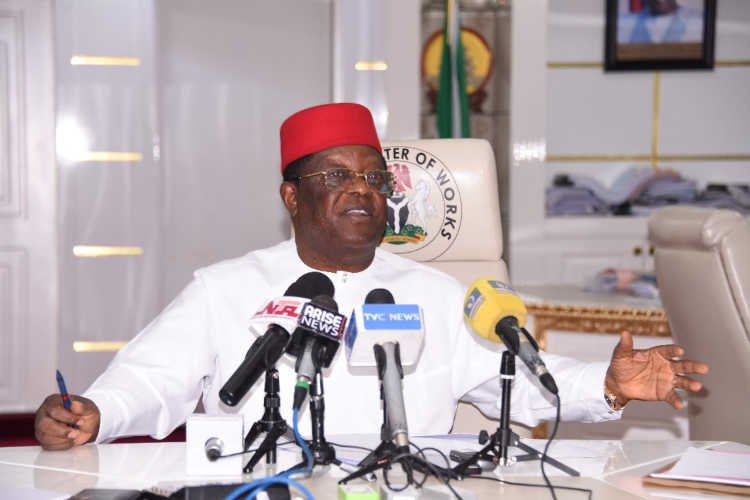
When a federal ministry plans to spend over N500 million on make-up artists, hairdressers, grinding machines, motorcycles and mini-vans, it raises concerns that Nigeria’s budget is being used for giveaways and consumption rather than addressing real public needs.
Development Diaries reports that according to details of the 2026 Appropriation Bill, the Federal Ministry of Works has proposed to spend over N500 million on the training of hairdressers, makeup artists, supply of grinding machines, motorcycles, mini-vans and anti-drug abuse sensitisation/advocacy in selected states of the federation in 2026.
We understand that the items and services were distributed across select locations within the country’s geographical zones.
Now, the Ministry of Works exists to build and maintain infrastructure, not to run empowerment schemes that look more like constituency giveaways than national development planning.
Nigeria’s budget has a long-running habit of dressing non-core spending in friendly labels like ’empowerment’ or ‘sensitisation’.
On the surface, these items sound helpful, but once you ask the basic public finance question, what public problem does this solve, and who is responsible for the result? The answers disappear.
Training hairdressers or buying grinding machines does not fix roads, bridges or public works, and no clear outcome is attached to these expenses.
This is the system failure Development Diaries would keep pointing out. Budgets are meant to fund public goods, yet ministries are spending outside their legal mandates.
Empowerment items are being used to bypass proper social protection systems. Consumables and personal services are procured in ways that make impact almost impossible to track.
On top of that, spending is scattered across zones, repeating what other MDAs already claim to do, without coordination or results.
This pattern is not accidental. Items like make-up services, hair training and grinding machines are easy to inflate, hard to verify and perfect for quiet distribution.
There is no clear way to measure success, no long-term value, and little public scrutiny once the money is released. In effect, the budget becomes a soft cash-out system hiding in plain sight.
This matters even more now because Nigeria is under serious fiscal pressure. Debt is rising, and key sectors like health, education, power and security are struggling.
N500 million could equip primary health centres, supply learning materials to schools, improve electricity infrastructure, or strengthen existing social protection programmes.
Choosing instead to scatter funds on non-essential items is a policy decision, not an accident.
Nigerian must now ask hard questions and demand answers from specific authorities. Why is the Federal Ministry of Works funding personal services instead of doing its job?
Who exactly receives these grinding machines, vehicles and trainings, and how are they chosen? Why are empowerment projects not routed through national social protection programmes?
The Budget Office of the Federation and the National Assembly must reject non-core spending during budget review. The Auditor-General must audit outcomes, not just paperwork, and the Ministry of Finance must publish beneficiary data for every empowerment line.
This is not about hair or machines; it is about whether Nigeria’s budget serves citizens or discretion. Development Diaries will keep naming these lines, because public money deserves public answers.
Photo source: FMWNIG