





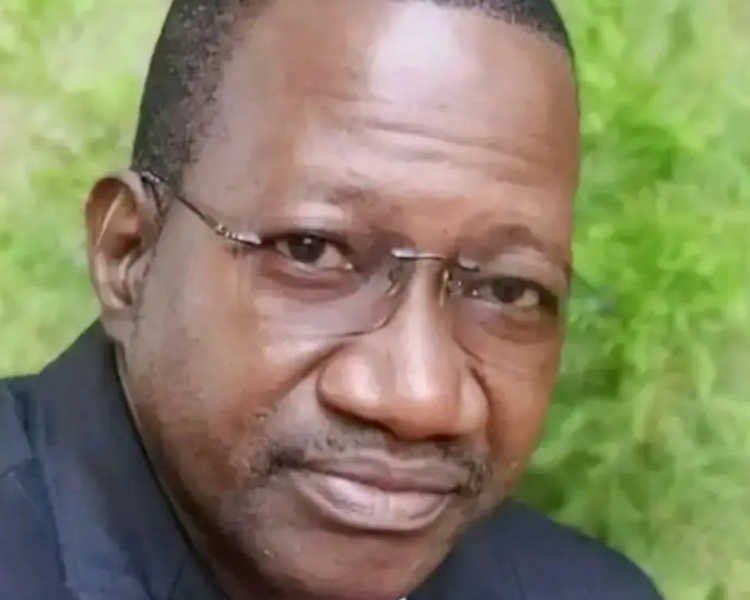
The jailing of a prominent journalist, Youssouf Sissoko, shows how press freedom in Mali is under serious threat.
Development Diaries reports that Mali’s junta has jailed a prominent journalist, Sissoko, sparking renewed concerns over media freedom in the country, according to Human Rights Watch (HRW).
According to Malian journalists, police arrested Sissoko, editor-in-chief of the weekly newspaper L’Alternance, at his home in Bamako, Mali’s capital, on 05 February.
The police took Sissoko before a cybercrime unit prosecutor, who charged him with spreading false information and insulting a foreign head of state, among other offences, and ordered him held in pretrial custody.
Arresting a newspaper editor for questioning a public statement made by a political leader sends a strong warning to other journalists that criticism and scrutiny may lead to prison.
This creates fear in the media space and weakens the role of the press in holding power to account, because if journalists cannot question leaders without facing arrest, then citizens lose access to balanced and truthful information.
Since taking power in a 2021 coup, Mali’s junta has cracked down on independent voices by suspending media outlets, dissolving civil society organizations, abolishing multiparty politics, and filing criminal cases against government critics.
In January, the Ministry of Territorial Administration went further by issuing a decree banning the circulation and distribution of Jeune Afrique, one of the continent’s most influential news publications.
This development raises clear human rights concerns. Freedom of expression and freedom of the press are protected under international law, including Article 19 of the Universal Declaration of Human Rights and the International Covenant on Civil and Political Rights, to which Mali is a party.
These rights allow journalists to report, question, and analyse public issues without intimidation. Charging Sissoko under a cybercrime law for ‘insult’ and ‘false information’, without clear definitions, shows how vague laws can be used to silence critical voices instead of protecting national security.
Mali’s authorities also have obligations under regional human rights standards such as the African Charter on Human and Peoples’ Rights, which guarantees the right to receive and share information.
The use of pretrial detention, the banning of media outlets like Jeune Afrique, and the suspension of civil society groups all point to a shrinking civic space where dissent is treated as a crime.
This pattern of repression weakens democratic values and limits citizens’ ability to participate in public life through informed debate.
Malians should demand the immediate release of Sissoko and the dropping of all charges linked to his journalism. They should call on the authorities to stop using the cybercrime law to silence criticism and to amend it so that ‘insult’ and ‘false information’ cannot be used as excuses to jail journalists.
Citizens should also demand an end to arbitrary arrests, media bans, and intimidation, and insist that the government respect its constitutional, regional, and international obligations to protect freedom of expression.
The government should understand that questioning those in power is not a crime, and a free press is essential to Mali’s future.
Photo source: HRW