




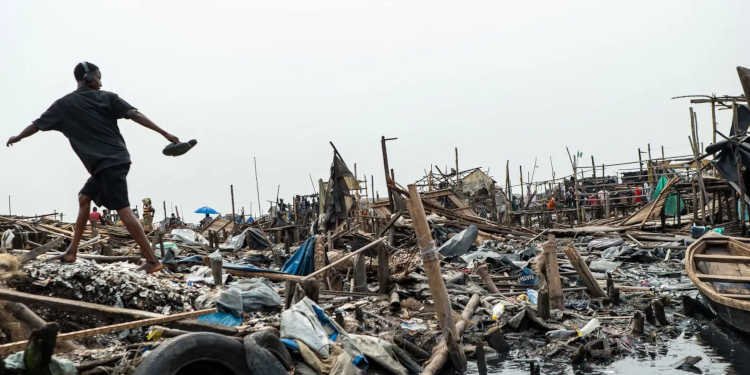
The demolitions in Makoko, Ekun-Agbo and Shogunro areas of Lagos State are being discussed as a housing or safety issue, but this is an education story, a governance story, and a rights story, because the quickest way to manufacture out-of-school children is to destabilise where they live.
Development Diaries reports that after demolitions hit parts of Makoko, Ekun-Agbo and Shogunro, community school operators say over 1,000 children have been pushed out of school because families were displaced, traumatised, or now sleep in makeshift shelters and on canoes.
Some parents have relocated, some are homeless, and some children are reportedly sleeping in makeshift shelters and even on canoes.
Makoko is not just a waterfront settlement but a learning space for children whose education is already fragile.
The Lagos State Government says the demolitions were about safety and enforcing building setbacks near the Third Mainland Bridge and other infrastructure.
At the same time, the House of Assembly has ordered a halt to further demolitions and asked for transparency about the task force and the criteria used.
Governor Babajide Sanwo-Olu has accused some non-governmental organisations of using Makoko as a ‘cash cow’, suggesting that they raise foreign funds but fail to deliver real change.
That accusation shifts public attention, because instead of asking, ‘What is the resettlement and schooling plan for displaced children’? the debate risks becoming, ‘Are NGOs making money from poverty’?
Even if some NGOs are ineffective, that does not answer the core issue. If government action has disrupted children’s education, the responsibility to fix that disruption does not disappear because of claims about NGO behaviour.
The real system failure here is the absence of clear safeguards before demolition. If safety was the reason, then residents should see published boundary maps, notice timelines, compensation criteria, and a relocation plan that protects schooling.
When over 1,000 children are pushed out of class, an emergency education plan should follow immediately. Temporary learning spaces, support for re-enrolment, and tracking of affected pupils should not depend on charity. Education continuity is a public duty, not an optional add-on.
Citizens should demand that Lagos State publish, within seven days, the legal basis and boundary map for the Makoko demolition, clearly showing the affected areas and the agencies involved.
They should also demand, within 14 days, an immediate schooling continuity plan with temporary learning spaces, transport support where needed, and a system to track every displaced child back into school.
The state government should create a public register of affected homes and schools, with clear rules for compensation and a complaint channel with response timelines.
Citizens can also help by documenting affected schools and pupils, following the House of Assembly process closely, demanding regular enforcement updates, asking for a written stop order with penalties, and pushing for a Child-First Makoko Charter that protects schooling during any future action.
If Lagos State wants to show that renewal is serious and not symbolic, the simplest test should be to get the displaced children back into school quickly, safely, and with a plan that citizens can see in writing.
Photo source: Vanguard