



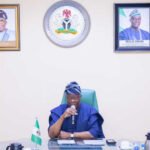



The launch of the Happy Woman App and the expansion of the Nigeria for Women Programme are being presented as a success story, but for citizens, this is really a public system test.
Development Diaries reports that the federal government recently launched a new digital platform aimed at deepening women’s economic inclusion.
According to a report by NairaMetrics, a statement from the Presidency noted that the ‘Happy Woman App Platform ‘ is a secure digital interface designed to connect Nigerian women to finance, skills development, markets, essential services, and government support.
The launch of the app coincided with President Bola Tinubu’s announcement to scale up the Nigeria for Women Programme (NFWP) to reach 25 million beneficiaries across the country.
The real question is not how impressive the launch looks, but whether this platform will measurably expand women’s economic rights or become another programme with big targets, weak delivery, and uneven access.
This puts Nigeria’s women’s economic inclusion system in focus, the way women reach livelihoods support, finance, markets, and public services through digital channels.
There are several reasons why the system often fails in Nigeria. Programmes start with strong promises at the federal level but weaken at the last mile through states, local governments, and community structures.
Many women may be excluded because of smartphones, data costs, literacy levels, language barriers, disability access, or lack of identification documents.
There is also the risk of leakage and gatekeeping, where intermediaries control ‘beneficiary lists’ or demand informal fees. If the terms of ‘finance’ are unclear, women could also be exposed to hidden charges, predatory loans, or misuse of their personal data.
From a rights and equity lens, this is about equal economic opportunity. If the design is wrong, the women most in need could be left out, for example, rural women without network access, poor urban women who cannot afford data, women with low literacy, women with disabilities, women whose phones are controlled by others at home, and women without IDs.
If the ’25 million women’ target is not broken down by poverty level, disability, location, and age, then it is a political number, not a true inclusion plan.
Here is what we can demand as citizens. Demand a public dashboard showing monthly registrations, active users, women receiving skills and finance, and results by state and group.
Push for clear disclosure if loans are involved, a toll-free grievance line, and offline enrollment points through community centres and local offices.
Concerned authorities must now take clear responsibility for how this programme works in practice. The Federal Ministry of Women Affairs and Social Development must set and enforce strict delivery standards for the Nigeria for Women Programme.
The Federal Ministry of Communications, Innovation and Digital Economy and NITDA must ensure the app meets strong digital, security, and accessibility standards.
The Federal Ministry of Finance and the Federal Ministry of Budget and National Planning must ensure public funds are tied to measurable results.
The Federal Ministry of Trade and Investment and the Federal Ministry of Agriculture and Food Security must support real market access for women’s businesses, not just registration numbers.
State and local governments must ensure proper community mobilisation and support for Women Affinity Groups on the ground.
At the same time, the Nigeria Data Protection Commission (NDPC) must enforce strict data privacy rules, while the Federal Competition and Consumer Protection Commission (FCCPC) must protect women from hidden charges or predatory financial terms if credit is involved.
Any partner banks or fintech firms must clearly disclose pricing and consumer protections. As the financier, the World Bank/IDA must insist on transparency, safeguards, and independent verification of results before this expansion is celebrated as a success.
The success of this platform will not be judged by the launch, but by whether women can safely access it, use it, and see real improvements in their economic lives.
Photo source: BAT/X