




The National Bureau of Statistics’ (NBS) rebased Gross Domestic Product (GDP) report’s claim that Nigeria’s economy now stands at N372.82 trillion, sharply contrasts with the country’s deepening poverty.
Development Diaries reports that this figure follows the rebasing of Nigeria’s GDP report, which stated that Nigeria’s economy grew by 3.13 per cent in the first quarter of 2025 from the 2.27 percent recorded in the same period in 2024.
According to media report, the Statistician General of the Federation, Adeyemi Adeniran, during a press briefing, said the economy was rebased from the 2010 base year to 2019.
While the figures seem impressive on paper, placing real estate ahead of crude oil in contribution to GDP and capturing activities in the informal sector like mobile payments and digital services, millions of Nigerians continue to face harsh economic realities.
Despite the rebasing of Nigeria’s GDP, Nigeria still retains its position as the fourth largest economy in terms of nominal terms.
Furthermore, despite these glowing metrics, over 133 million citizens remain multi-dimensionally poor, and the World Bank projects that poverty in the country will worsen by 3.6 percent in the next five years.
This contradiction reveals a glaring disconnect between growth data and the lived experience of the average Nigerian.
Citizens are not feeling the impact of this so-called growth. Instead, purchasing power is at an all-time low, inflation remains stubbornly high, and essentials such as food, healthcare, and transportation are increasingly out of reach for the average household.
Despite a proposed minimum wage increase from N33,000 to N70,000, many Nigerians say their purchasing power has dropped, as N70,000 today buys far less than N33,000 did just a few years ago.
For most households, rising GDP figures offer no relief from soaring costs, stagnant wages, and a deteriorating quality of life.
What then is economic growth if it doesn’t translate into jobs, affordable food, quality education, and healthcare?
A rebased GDP that includes streaming subscriptions, short-let apartments, and mobile banking services may reflect a broader economic structure, but it does little for a market woman in Onitsha struggling to feed her family or a schoolteacher in Kano watching her salary shrink in value.
When citizens are surviving rather than thriving, the promise of economic prosperity rings hollow.
The truth is, statistical growth without visible improvement in living standards raises more questions than celebration.
The naira’s steep devaluation has eroded real income, and even the much-touted new minimum wage cannot buy what a lesser amount could a few years ago.
It’s not enough to tell citizens that the economy is expanding, they need to see it, feel it, and live it.
Without deliberate investments in public infrastructure, agriculture, manufacturing, and human capital, the growth we’re celebrating will remain top-heavy, benefitting the few at the expense of the many.
It’s time to move beyond congratulating ourselves for bigger numbers and start asking harder questions: How is this bigger economy serving the people?
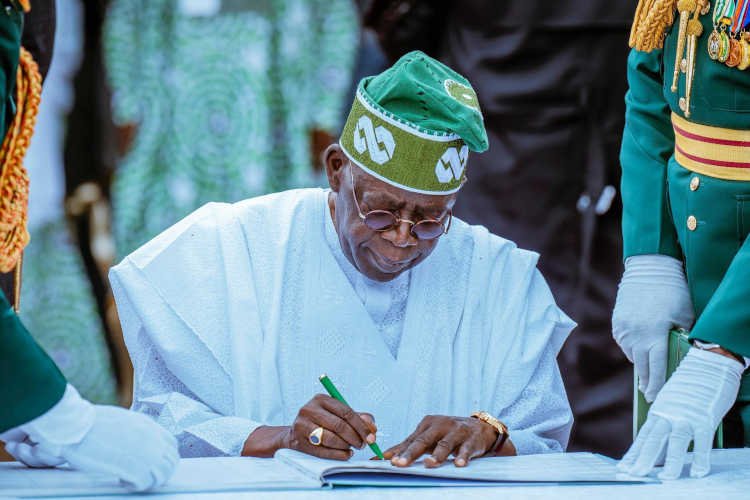
Development Diaries calls on President Bola Tinubu, the ministers, and state governments to commit to people-first policies, tackling inflation, boosting local production, supporting small businesses, and strengthening the naira. Nigerians don’t eat GDP.
They need results that show up in their wallets, their homes, and their futures. Until then, every upward revision of the economy only reminds us how far reality still lags behind the rhetoric.