




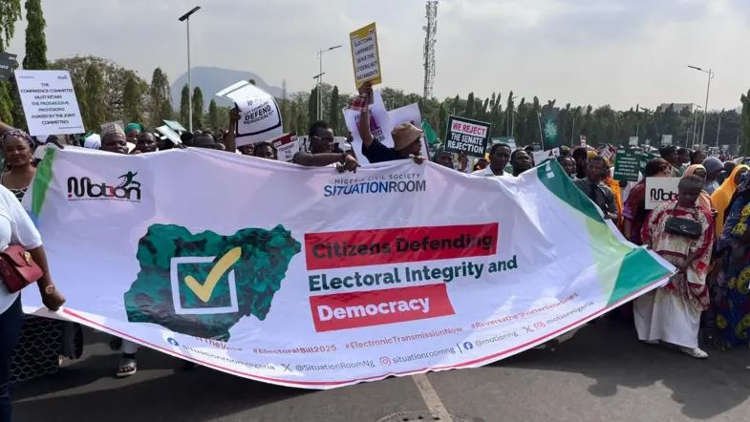
Monday’s protest at the National Assembly over the Nigerian Senate’s ‘rejection’ of the electronic transmission of election results is a reminder that the people, who actually own the country, may be tired, but they are not asleep.
Development Diaries reports that from civil society groups to women’s collectives, from young people holding placards to older Nigerians, the protesters gathered at the National Assembly entrance in Abuja to insist that lawmakers must clearly and boldly put in the Electoral Act Amendment Bill the words ‘real-time electronic transmission of election results’.
Of course, the peaceful protesters met the usual government response to protests as personnel of the police, the army, and the civil defence were deployed in the area to make it look like Abuja was expecting an alien invasion.
In its defence, the Senate had insisted it did not reject electronic transmission but only removed the word ‘real-time’, which is the single word that gives the entire provision meaning.
But is that not like returning someone’s car keys while quietly removing the engine?
According to Senate President Godswill Akpabio, leaving ‘real-time’ could create legal problems if network fails. That logic is interesting because in Nigeria, when something fails, we rarely fix it.
Instead of improving network capacity, investing in better infrastructure, or demanding efficiency from the Independent National Electoral Commission (INEC), our lawmakers rewrite the law to accommodate failure.
Even former Senate President David Mark had to remind the serving lawmakers that INEC, not politicians, should decide the method of transmitting results. But this reminder still does not change the fact that the Senate’s wording weakens transparency, and citizens know it.
That is why Monday’s protest was so important, because it was democracy breathing fresh air.
This is the exact public pressure Nigeria needs. We need to remain alert, to engage our lawmakers, to ask difficult questions, and to resist subtle attempts to water down electoral transparency.
Yet, this cannot be a one-off moment. The Senate has now scheduled an emergency plenary session, and while no official reason has been given, the timing suggests that citizen pressure works.
So when people show they are watching, the political class suddenly becomes very interested in meetings.
But what happened on Monday is a wake-up call to every Nigerian who has ever complained about elections but never engaged their representatives in the National Assembly.
Politics is too serious to be left for politicians alone. So if you did not join the protest, democracy still expects something from you. Call your senator, write an email, visit their constituency office, and insist that your vote must be counted the same way you cast it.
Real-time results matter, as they remove space for manipulation, protect the integrity of votes, and reduce the ‘magic results’ that appear hours later from unknown locations.
So yes, the protest should extend to Nigerians carrying the same energy back to their constituencies. Let every lawmaker know that hiding behind vague wording will not pass unnoticed. Let them feel the pressure of citizens who understand the law and refuse to be confused by political English.
To every protester who stood under the Abuja sun, Development Diaries salutes your courage. To every citizen following from home, this is your reminder that democracy works best when people show up and are actively involved in governance, not only on election days.
As the emergency session holds on Tuesday, every senator present should know that the Nigerian people – from whom the government derives all its powers, authority, security, and legitimacy – are watching.
Photo source: BBC