





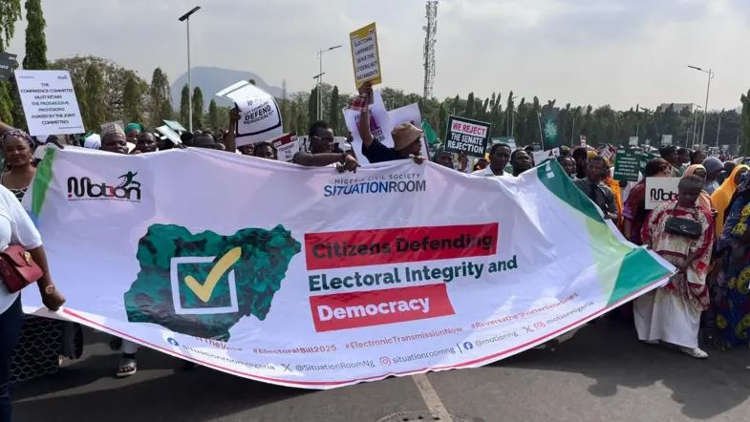
Federal lawmakers in Nigeria are meeting again this week, and for ordinary Nigerians who just want their votes to count without drama, the real concern is whether the legislators are harmonising the Electoral Act, or quietly harmonising the interests of the party in power at the people’s expense.
Development Diaries reports that the two chambers of the National Assembly, the Senate and the House of Representatives, are expected to meet to take a common position on the method of election result transmission from polling centres to the Independent National Electoral Commission’s (INEC) result portal.
If you ever needed a reminder that Nigeria’s democracy can behave like a generator, starting with hope, stalling with noise, and sometimes refusing to come on at all, just look at the latest drama over electronic transmission of election results.
Last week, the Senate almost turned into a live episode of ‘Who Wants to Amend a Law?’ before they paused the shouting match and rushed into an emergency meeting to ‘clarify’ things.
Of course, Nigerians were not convinced because when politicians start clarifying, it usually means something somewhere is becoming cloudy.
Ahead of Monday’s meeting, the nation’s capital, Abuja, is already bubbling with lobbying, with the ruling All Progressives Congress (APC) appearing to be the one stirring the pot the hardest, pushing for the Senate’s softer, more flexible version of Section 60(3).
And by ‘flexible’, they mean the kind of flexibility that allows results to be transmitted electronically, but only if the system does not suddenly ‘fail’.
Well, Nigerians have seen this movie before, as network usually fails only when the ruling party needs it to.
On the other hand, the House of Representatives prefers the real-time transmission model that civil society groups, including ImpactHouse Centre for Development Communication, and opposition parties are backing.
Their version insists that results must leave the polling unit immediately, not after somebody’s uncle in the collation centre has ‘reviewed’ it with tippex and ‘pure-water’ motivation, while the Senate deleted the phrase ‘real time’ and introduced a magical escape door of ‘if the network fails, use the manual Form EC8A’.
Election observers have since reported that the EC8A is where results go to disappear and later reappear with new handwriting, with former IPAC Chairman Peter Ameh putting it more plainly than most politicians dare.
‘The Senate version is nothing but a ‘cosmetic tinkering’ of the law’, he said.
In short, that is the kind of loophole you insert when you want to pretend you are reforming the system while actually protecting the backdoor.
Meanwhile, both chambers are controlled by the same ruling party, so the APC is not relying on faith alone, as they are lobbying heavily, ensuring that the Senate’s version, which is ‘convenient’, elastic and open to ‘network failure miracles’, is given more love than the House’s strict transparency model.
Insiders say the Senate members of the committee are pushing for their version with the kind of energy usually reserved for campaign season, while the House members insist that Nigeria cannot be recycling old electoral loopholes in 2026.
But beneath all the legislative drama is the fact that Nigerians just want to see their votes counted exactly as they were cast, because trust in elections is already running on a low battery.
And that is why this harmonisation matter is no small issue. It is the difference between an election where results speak for the people and an election where results speak for the highest bidder.
It is also the difference between citizens having faith in the ballot and citizens abandoning polling units out of frustration.
What must happen now? Citizens must ask their lawmakers to remove any ambiguity and stand firmly for real-time electronic transmission, because that is the only version that protects our votes, reduces manipulation, and strengthens trust in our elections.
Lawmakers must reject any loophole that allows results to travel ‘when network permits’, because Nigeria’s network has been known to permit everything except transparency during elections.
Today, our lawmakers have a choice of either protecting the people or protecting the loopholes.
Photo source: BBC