






If there was ever a moment for President Bola Tinubu to surprise Nigerians in a good way, it would have been by rejecting the Electoral Act Amendment Bill, 2026, especially its disputed provisions on election result transmission, but that moment never came.
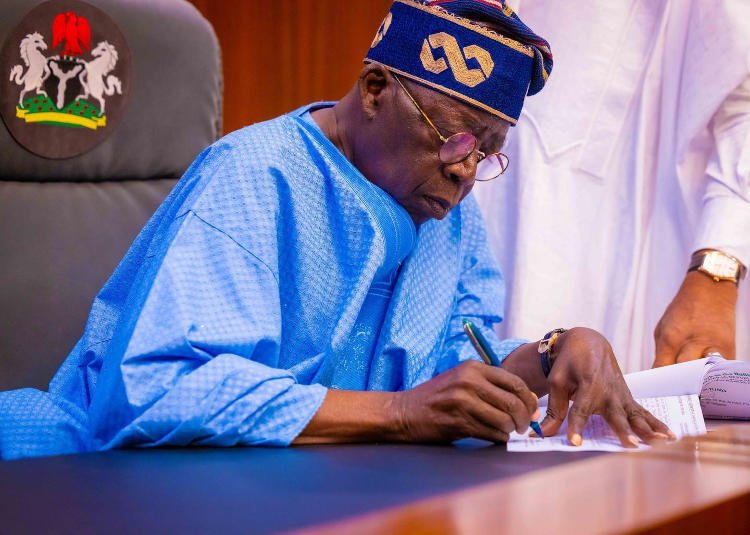
Development Diaries reports that the Nigerian leader on Wednesday signed the bill into law despite protests by Nigerians.
Imagine if the president had looked at the controversial amendment, noted the public outrage, remembered the 2023 trauma still stored inside citizens’ collective memory, and said, ‘No, thank you. Bring back the real-time transmission clause’.
That alone would have sent a political thunderclap across the continent and restored some of the trust that currently leaks out of our electoral system like a faulty generator.
Instead, he signed the bill with the speed of someone approving a budget for new curtains.
And so, here we are again, sharpening our pencils for 2027 while wondering if the results we see at polling units will match what emerges at collation centres.
With the president’s assent, the legislative drama is over, but the credibility battle has shifted squarely to the Independent National Electoral Commission (INEC).
INEC must now deliver elections under a law that leaves too much to chance and too much room for ‘network failure miracles’.
The amended Act removes the guarantee of real-time electronic transmission of results, the very safeguard that many citizens, civil society groups, and democracy actors demanded.
What we now have is manual transmission backed by electronic support ‘where possible’, a phrase that has historically meant ‘where politically convenient’.
This is a rights issue because Nigerians have a constitutional and democratic right to transparent elections. When laws allow ambiguity in how results are moved from polling units to collation centres, the right to vote freely and have that vote counted accurately becomes shaky.
Nigeria is obligated under the African Charter on Democracy, Elections and Governance to ensure credible, transparent, and participatory elections. Weakening electoral safeguards places the country at odds with its own commitments.
The system that is failing is Nigeria’s electoral governance structure. It is failing because political elites continue to prioritise control over credibility, electoral reforms are treated like bargaining chips instead of national commitments, and the people entrusted with protecting the vote often protect only their political interests.
The duty-bearers here are the president, the National Assembly leadership, the ruling All Progressives Congress (APC) caucus that aggressively pushed the Senate version of Section 60(3), and, of course, INEC, which must now administer an election under a weakened framework.
Also, the speed of the president’s assent, less than 48 hours after the National Assembly passed the bill, was not administrative efficiency but strategic timing.
Approving the bill early allows the ruling political class to settle into campaign mode with a law tilted subtly in their favour. It also shifts public pressure away from the presidency and towards INEC, creating the impression that implementation, not the law itself, is the real problem.
Nigerians demanded real-time transmission because they understand the implications of manual processes in a country where result sheets often disappear, reappear, and travel more widely than some citizens have ever travelled in their lives.
Women, young people, persons with disabilities, and first-time voters, groups most often marginalised during elections, stand to lose the most when transparency is diluted.
So what can citizens do now? Refuse to be silent by demanding that INEC release a clear, unambiguous operational guideline that prioritises electronic transmission regardless of the loopholes in the law.
Citizens should push lawmakers to revisit the clause, and insist that political parties commit publicly to transparent collation processes.
INEC, on its part, must design a process that leaves no room for creative interpretation of results, while the judiciary must prepare for an avalanche of cases and deliver justice without political calculators under the table.
If Nigeria wants 2027 to be peaceful, credible, and broadly accepted, then it must deliver an electoral process that women, young people, PWDs, and everyday citizens can trust.