






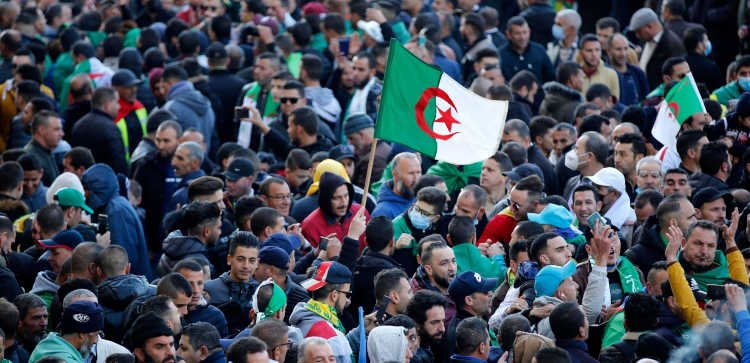
The prosecution of Mohamed Tadjadit and 12 other Hirak activists is a serious attack on fundamental rights in Algeria.
Development Diaries reports that, according to Amnesty International, the activists are facing charges of ‘conspiring to incite citizens against the authority of the state and to undermine national unity’ (Articles 77 para 1, 78 and 79 of the Penal Code).
It is understood that this criminal charge is punishable by up to 30 years in prison and by the death penalty.
These men are being charged with offenses that carry extremely heavy penalties, including the death sentence, simply for expressing their opinions and joining peaceful protests.
As Amnesty International noted, ‘It is utterly appalling that activists in Algeria…are facing heavy prison sentences and even the possible risk of the death penalty, simply because they advocated for political reforms’.
This development shows a deepening pattern of repression and a shrinking civic space.
Algeria has clear obligations under international human rights law to respect freedom of expression, peaceful assembly, and fair trial guarantees.
Having ratified key human rights treaties, including the International Covenant on Civil and Political Rights (ICCPR), the African Charter on Human and Peoples’ Rights, and the Convention Against Torture, these instruments obligate Algeria to protect freedom of expression, peaceful assembly, and fair trial rights.
Hence, the use of vague security laws to prosecute peaceful activists goes against these commitments.
Amnesty International also warned that ‘the authorities’ misuse of vaguely worded security laws to silence their critics is a grave injustice that must cease’. A state that has signed these treaties cannot ignore its own legal obligations.
There are also serious concerns about due process. Prosecutors are using social media posts and private messages as evidence of ‘undermining national unity’ and ‘receiving foreign funds’, even though these posts simply expressed frustration with socio-economic conditions and support for protests.
Some of the same materials have been used to convict the activists in earlier cases, raising questions about double jeopardy.
The heavy penalties attached to these charges, including up to 30 years in prison and possible execution, do not meet the international standard that the death penalty be limited to the ‘most serious crimes’, meaning intentional killing. These cases fall far outside that definition.
This case is a direct test of Algeria’s commitment to basic freedoms. Authorities must stop criminalising dissent, drop the charges, and release all activists detained for peaceful expression.
The government must also abolish the death penalty and strengthen legal protections for civic freedoms. The international community, including the African Union and UN human rights mechanisms, should speak loudly and clearly. Algeria must act now, free the activists, end these abusive prosecutions, and reopen the civic space.
Photo source: AFP/Getty Images