




With the 2027 general election in Nigeria less than a year away, the major opposition parties look less like a coordinated political force and more like a group project where nobody agreed on the topic.
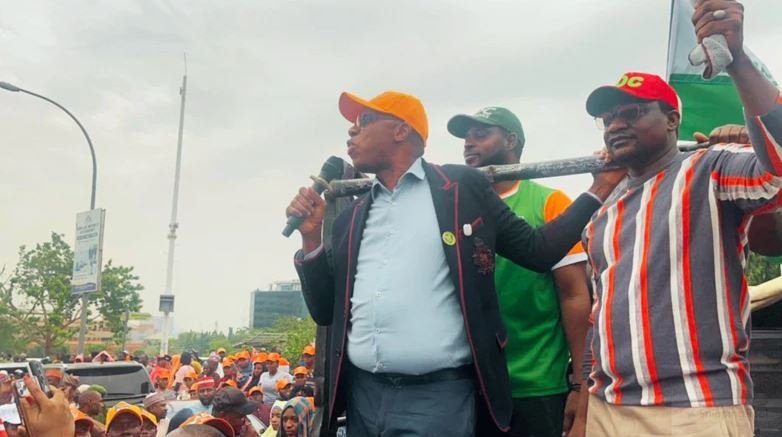
Development Diaries reports that this week, the African Democratic Congress (ADC) found itself in the kind of drama that makes Nollywood writers feel threatened as a faction loyal to former presidential candidate Dumebi Kachikwu openly backed the move by Independent National Electoral Commission (INEC) to de-register the leadership led by David Mark.
Before citizens could even process that, the matter had already entered courtrooms, commentary columns, and WhatsApp debates, where Nigerians now gather as unofficial constitutional lawyers.
At first glance, it looks like a party fighting itself, but if you look closer, it starts to feel like something bigger, more systematic, like a slow cooking process where opposition parties are the main ingredients.
To understand what is happening, let us rewind a bit.
In the 2023 elections, the ADC fielded Kachikwu as its presidential candidate and managed to secure over five percent of the vote. In Nigeria’s political environment, that is not a small achievement.
But after the elections, the internal structure of the party began to wobble, as leadership disputes emerged, alliances shifted, and before long, the party became less about policy and more about who controls the steering wheel.
Before the ADC crisis gained prominence, the main opposition party, Peoples Democratic Party (PDP), was busy settling internal disagreements, while the Labour Party, which energised young voters in 2023, had been navigating its own share of internal tensions and defections.
And in the middle of all this fragmentation, the ruling All Progressives Congress (APC) is watching events like a political gladiator picking his teeth.
Now, here is where things get interesting. INEC does have the constitutional power to de-register political parties that fail to meet certain electoral thresholds, and that part is not in dispute.
But when it comes to stepping into internal leadership disputes, the legal ground becomes a bit shaky, like a referee who suddenly decides to join the match.
So a key focus is how INEC is using its power because an electoral body that prides itself on independence must be seen to be neutral, with clear, consistent, and publicly verifiable actions.
So far, Nigerians have not been shown a transparent record that proves that regulatory actions are being applied evenly across all parties, regardless of political alignment.
And that brings us to the bigger issue, because when opposition parties spend more time fighting themselves or defending their existence than engaging citizens, democracy suffers.
One of the first places this shows up is in who gets pushed out of the political space, and it is often women who feel it first. Securing party nominations is already an uphill battle for many female candidates, and when parties become consumed by internal survival, that hill quietly turns steeper.
Young people also feel the impact, as the doors they hope to enter begin to close while parties focus more on staying alive than on being inclusive.
As for persons with disabilities, who already face structural barriers in political participation, they are pushed even further to the margins as opposition parties spend more time fighting themselves or defending their existence than engaging citizens.
So, what should citizens do in the middle of all this?
First, pay attention to developments. Second, insist that INEC clearly publishes the legal basis for its actions, not just in this case, but across all political parties since 2023. Third, engage representatives, as members of the National Assembly should be asked what oversight they are exercising over electoral regulation.
If opposition parties continue to disappear through internal collapse and regulatory pressure, then the question citizens must keep asking is ‘who is left to challenge power’?
Photo source: Chukwunaeme Obiejesi/BBC