

Nigeria cannot claim to be serious about fighting poverty when it sets aside just 0.35 percent of its 2026 budget for that purpose.
Development Diaries reports that the federal government plans to spend about N206.50 billion on poverty alleviation-related projects in the 2026 budget.
It is understood that this amount represents far less than one percent of the total N58.47 trillion spending proposal submitted to the National Assembly.
In a country where six in ten people are poor, this is not a funding gap. It is a choice.
Measured against the proposed total budget of N58.47 trillion, this means only about 0.35 percent of federal spending is set aside for poverty-related programmes in 2026.
Even when compared only to the capital budget of N23.21tn, the allocation to poverty interventions is still less than one percent, at roughly 0.89 percent.
A review of project-by-project data in the 2026 Appropriation Bill shows that all spending clearly marked for poverty alleviation, across ministries, departments, agencies, and the service-wide vote, adds up to N206.5 billion.
The numbers show a government comfortable managing poverty, not reducing it. When almost the entire allocation sits in a central service-wide vote and MDAs are left with scattered, tiny projects, the message is clear, that poverty is not being treated as an emergency.
Citizens must now turn their attention to the National Assembly, especially the Senate and House Committees on Appropriations.
Lawmakers have the power to reject this allocation and mandate a clear, time-bound increase toward at least one–two percent of GDP for social protection, in line with regional standards.
Passing a 0.35 percent allocation would make the legislature complicit in sustaining mass deprivation.
There is also the problem of who really benefits from poverty spending. Here, scrutiny must fall on implementing ministries, departments, and agencies, including the National Social Investment Programme (NSIP) and National Poverty Reduction with Growth Strategy (NPRGS) management offices.
Poverty votes should not be used for retreats, office equipment, foreign trips, or vague ‘strategic activities’. Nigerians should insist that every naira tagged as poverty alleviation delivers a direct household benefit, with clear beneficiary lists and timelines made public.
Every naira should translate to a direct household benefit. Alongside this, Nigerians should insist on a beneficiary-first budget, who gets support, where they live, and why they were chosen. Allocations must follow poverty data, not political maps. No data, no approval.
We must demand an end to the fiction of so-called ‘poverty projects’. Tricycles, motorcycles, grain handouts, workshops, and symposiums are not a poverty strategy.
Transparency is another weak point, and this again rests with the Ministry of Budget and Economic Planning. When reports show that only about 44 percent of safety-net benefits reach the poor, silence is not an option.
Nigerians should demand a beneficiary-first budget that clearly shows who gets support, where they live, and why they were selected, using poverty data rather than political geography.
Alongside this, the Office of the Auditor-General of the Federation must publish independent audits of NSIP and NPRGS, name implementing partners, and account for leakages, especially when evidence suggests that only about 44 percent of benefits reach the poor.
Cash transfers and food support should automatically scale up when inflation jumps or fuel prices rise, not after delays and press releases.
Finally, poverty policy must be stabilised and protected by law. This is the responsibility of the National Assembly, working with the executive. Nigerians should demand legislation that automatically scales up cash transfers and food support when inflation rises or fuel prices increase, instead of late and discretionary responses.
At the same time, poverty reduction must be tied to jobs, food prices, MSME productivity, and real wages, not fragmented MDAs spending small sums in isolation.
It has been proven that Nigeria is budgeting for poverty management, not poverty reduction.
Until the Presidency, the Budget Office, the National Assembly, implementing agencies, and oversight institutions face sustained public pressure, mass poverty will remain underfunded by choice.
We as citizens must demand answers, track decisions, speak up, protest peacefully, and vote with memory. Poverty will not end on its own, and silence only protects failure.
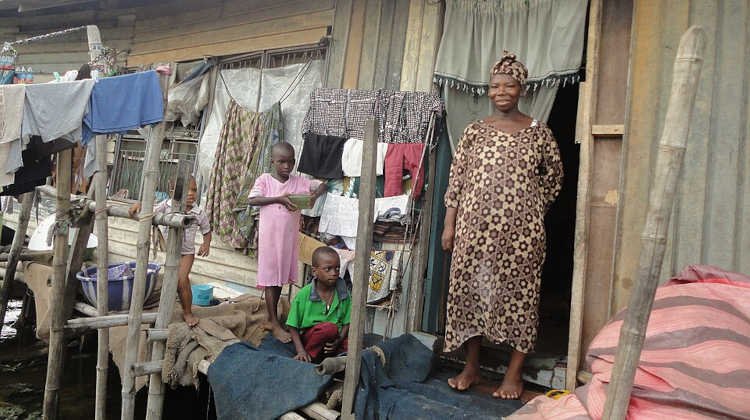
Photo source: CEE-HOPE NIGERIA