

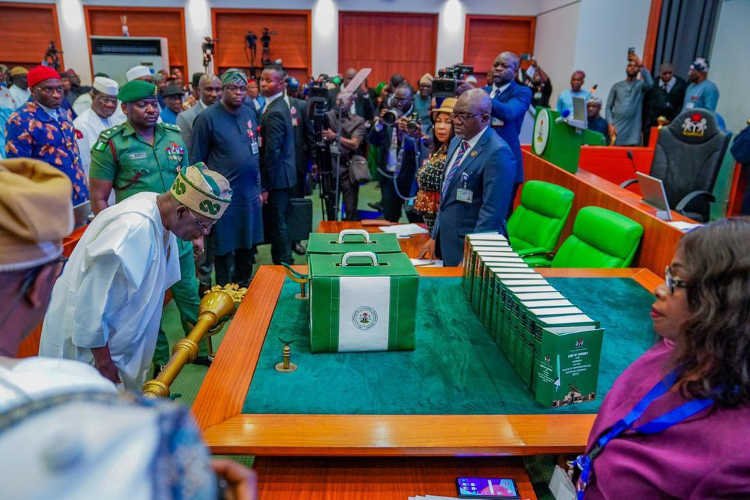
The recent revelation by BudgIT that the National Assembly inserted 11,122 projects worth N6.93 trillion into the 2025 budget reinforces the unsettling reality that Nigeria is still not taking transparency in public finance seriously.
Development Diaries reports that, according to BudgIT’s latest publication, a total of 11,122 projects culminating in N6.93 trillion were inserted in the 2025 budget by the National Assembly.
Despite being a signatory to several open governance and anti-corruption frameworks, including the Open Government Partnership (OGP), Nigeria’s budget process remains shrouded in opacity.
The fact that thousands of projects were added post-executive submission, many of which do not align with the Medium-Term National Development Plan or national priorities, suggests that public interest continues to be undermined by legislative impunity and a lack of political will to enforce transparency.
The dangers of this development are both immediate and long-term.
Firstly, such indiscriminate budget insertions distort national planning and resource allocation, often leaving critical sectors like health, education, and infrastructure underfunded or neglected.
Secondly, padding the budget with projects that do not make sense reinforces a system of favouritism in which public funds are used to reward political allies and cronies rather than improve public welfare.
Furthermore, the scale of these insertions, some exceeding five billion naira per project, raises serious questions about procurement, oversight, and eventual implementation.
Also, investor confidence, already fragile due to policy inconsistency and economic instability, is further eroded by such revelations.
Foreign investors look for fiscal discipline, transparency, and predictability, three qualities that are lacking in a budget process that allows lawmakers to inject N6.93 trillion in self-serving projects.
At a time when Nigeria is seeking to attract investment to diversify its economy and shore up dwindling foreign reserves, the signal this sends is deeply counterproductive.
Investors are unlikely to trust a system where budgetary allocations can be hijacked by political interests without recourse to sound economic justification.
This is not the first time budget padding or questionable insertions have made headlines. Under the previous administration, allegations of padded constituency projects, inflated contracts, and ghost allocations were common, with little or no action taken to hold those responsible accountable.
In the 2019–2022 budgets, former President Muhammadu Buhari consistently raised concerns over unauthorised insertions by the National Assembly.
For instance, in 2019, he noted an increase of N90 billion beyond the proposed budget. Similar issues arose in subsequent years, with the legislature adding projects worth hundreds of billions of naira without proper justification.
In 2016, allegations of budget padding by the National Assembly came up as a major scandal that eventually saw the removal of the then chairperson of the House of Representatives Committee on Appropriation, Abdulmumini Jibrin, from office.
More recently, in 2024, Senator Abdul Ningi alleged that over N53 billion worth of projects in the 2024 budget lacked specific locations, suggesting they were fraudulently inserted.
These issues have consistently been swept under the carpet.
It would not be out of place for President Bola Tinubu to respond directly and decisively to this issue. As head of the executive arm and the nation’s chief economic strategist, the president has both a moral and constitutional duty to defend the integrity of the national budget.
The silence or inaction that typically follows these discoveries only emboldens repeat offenders and encourages a culture of impunity.
Development Diaries calls on the Director-General of the Budget Office of the Federation, Tanimu Yakubu, to conduct an internal audit of all inserted projects in the 2025 Appropriation Act and make the findings public.
Also, in the spirit of accountability, the National Assembly must ensure that any project found to lack justification or alignment with national development goals is removed and persons responsible for such insertions held accountable.
We also call on President Tinubu to lead that charge in condemning this trend and breaking this pattern.