






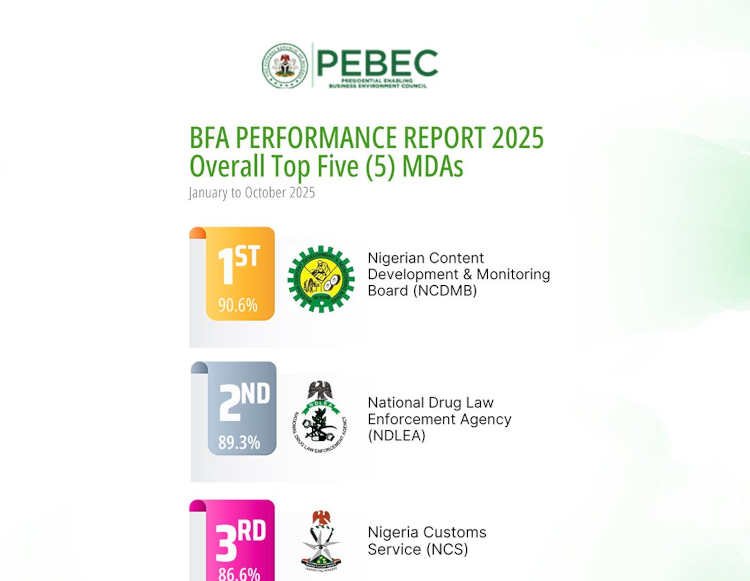
The latest Presidential Enabling Business Environment Council (PEBEC) report exposes a serious problem in Nigeria’s public sector, which demands serious attention.
Development Diaries reports that PEBEC, in its latest Business Facilitation Act (BFA) Performance Report, ranked as ‘completely inefficient’, no fewer than 17 federal government agencies.
The Performance Report rates how ministries, departments and agencies are enabling the ease of doing business in Nigeria through the implementation of reforms, policies and public service delivery.
17 federal agencies, including the Bank of Industry, Trademarks Registry, Environmental Health Council of Nigeria, Federal Produce Inspection Service, Galaxy Backbone, Industrial Training Fund, Joint Tax Board, National Identity Management Commission (NIMC), National Insurance Commission (NAICOM), and the National Bureau of Statistics, were ranked zero in efficiency by PEBEC.
Alongside the Nigerian Postal Service (NIPOST), the Patent and Design Registry, Service Compact (SERVICOM), the Nigerian Maritime Administration and Safety Agency (NIMASA), the Nigerian Copyright Commission, the Midstream and Downstream Petroleum Regulatory Authority, and the Financial Reporting Council, marking them as completely ineffective in meeting basic service delivery and reform obligations.
While 17 federal agencies scored zero in efficiency, many others performed poorly across transparency, service delivery, and responsiveness.
Agencies like NIMC, NIPOST, Galaxy Backbone, the Industrial Training Fund, and the Trademarks Registry are supposed to support business operations, yet their failure shows a system that is slow, outdated, and unhelpful to citizens and investors.
When an efficiency report looks more like a list of those asleep at work, it is clear that something is wrong. This poor performance also raises big economic concerns.
As experts have noted, Nigeria cannot talk about attracting investment, improving productivity, or building a strong economy when the very institutions that should make business easier are struggling to function.
Slow processes delay investment decisions, weak digital systems frustrate businesses, and corruption or poor staffing reduces confidence in the public sector.
Nigeria wants a stronger economy, but these results show that many ministries, departments and agencies (MDAs) are pulling the country backward instead of forward.
The report also points to deeper issues, poor follow-up by government, weak supervision, outdated processes, and lack of accountability.
It is also important to note that corruption, low motivation, and lack of proper staffing contribute to the failures. When agencies are not monitored, they simply carry on without concern for results.
This is why half of the assessed MDAs performed below acceptable levels. Without real consequences or clear expectations, many institutions will continue to do the bare minimum, leaving citizens to suffer the outcomes.
This should be a wake-up call to President Bola Tinubu, the Office of the Vice President, ministers overseeing underperforming MDAs, and the leadership of these agencies.
They must fix these weaknesses now by reviewing staff capacity, improving digital systems, enforcing service level agreements, and demanding accountability.
The agencies that scored zero must not treat this like a harmless report; they should take responsibility, explain the failures, and begin real reforms.
Nigeria’s growth depends on public institutions that work. Everyone involved, from agency heads to supervising ministers, must act now and show that public service can be better than this.
Photo source: PEBEC